
Best MDCAT Academy in Bannu 2026: Full Guide for KPK Students (+ Free Option)

Table of contents
- Choosing an academy in Bannu
- How MDCAT and KMU admissions work
- MDCAT 2026 exam structure
- Subject weightage
- Bannu Medical College and KPK colleges
- Merit and aggregate for Bannu students
- What to check before you pay
- Academy or online in the Bannu region
- The free option: Topperlot
- What preparation costs
- A six-month plan
- High-yield topics by subject
- Studying from Bannu and the southern belt
- Registration and exam day
- Mistakes Bannu students make
- Frequently asked questions
Students from Bannu city and the wider region, including North Waziristan, Lakki Marwat and Karak, sit the MDCAT every year hoping for a government seat in medicine or dentistry. Many want Bannu Medical College at home, others aim for Gomal in D.I.Khan, Kohat, or the Peshawar colleges. The result almost always comes down to how much quality practice you did and how honestly you reviewed it. This guide helps you get that right, at an academy or from your own room.
Choosing an academy in Bannu
Bannu is an important city for southern KPK, and it serves as an education and services hub for a large surrounding area, including students who come in from North Waziristan. But like most of the south, it has fewer well-resourced MDCAT academies than Peshawar or Abbottabad. That makes the choice you have more important, because a weak local academy can quietly cost you the marks you needed for Bannu Medical College or a seat elsewhere.
The plain truth is that the classroom does not earn your marks. Your score comes from the number of exam-style MCQs you solve, the mistakes you review, and the full tests you sit under time. A big local name does not change that, and a large fee does not guarantee a high score. Some Bannu students pay for coaching, attend for a while, and never build the daily practice habit that actually lifts a score. The academy that helps you most is the one that gets you practising and reviewing daily, and several ways of doing that now cost nothing, which matters a great deal where strong physical options are limited.
So before you commit money, it helps to understand what you are preparing for and what a good academy should give you. The rest of this guide covers both, with Bannu and its region in mind.
How MDCAT and KMU admissions work
The MDCAT follows one national curriculum set by the Pakistan Medical and Dental Council (PMDC), so a Bannu student sits the same standard of paper as anyone in Lahore. In KPK the test has been conducted through the provincial arrangement (ETEA), and admissions to public sector medical and dental colleges are run centrally by Khyber Medical University (KMU) in Peshawar through its online portal.
The path is clear. You register and sit the MDCAT, you get a score out of 180, then you apply to KMU during its admission window. KMU works out each applicant’s aggregate, puts everyone on one provincial merit list, and offers seats from the top down across all the public colleges. Because it is a single list, your aggregate alone decides which college you are offered, if any. You submit your college preferences, and the central system places you by merit and choice.
For Bannu this matters in a specific way. Bannu Medical College is in your city, but you are ranked against the whole province for it, not just against other southern students. So a strong aggregate is what keeps a home seat within reach. Confirm the conducting body, the exam date and the current formula for 2026 on the official KMU and PMDC sources, since these can change year to year.
MDCAT 2026 exam structure
Knowing the exact format is the first step to preparing well. The MDCAT is a paper-based multiple choice exam:
| Parameter | Detail |
|---|---|
| Total MCQs | 180 |
| Duration | 3 hours |
| Format | Paper-based MCQs |
| Negative marking | None |
| Medical (MBBS) pass mark | 55% (about 99 / 180) |
| Dental (BDS) pass mark | 50% (about 90 / 180) |
There is no negative marking, which students still forget. A blank is a certain zero, and a sensible guess has a real chance of scoring, so never leave a question empty and use elimination when you are unsure. The pass mark is only the minimum to be eligible. The merit for a government seat at a KPK college is far higher, which is why months of steady work beat a last-minute rush.
Subject weightage
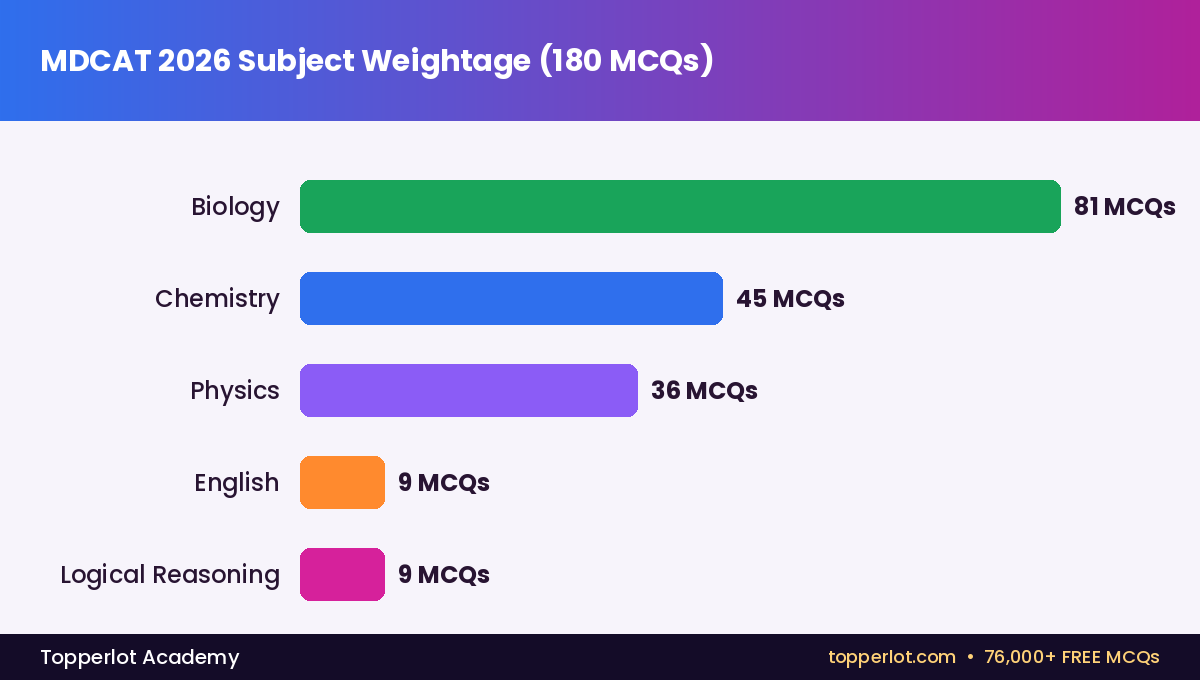
Your study hours should follow the marks. Biology is the largest block on the paper, so it should be the largest block in your plan:
| Subject | MCQs | Share |
|---|---|---|
| Biology | 81 | 45% |
| Chemistry | 45 | 25% |
| Physics | 36 | 20% |
| English | 9 | 5% |
| Logical Reasoning | 9 | 5% |
Biology and Chemistry together are 126 of the 180 marks, so your work in these two subjects mostly decides your merit. Give Biology the most daily time and Chemistry the second most. The 18 marks in English and Logical Reasoning are easy to secure, so do not ignore them. Practise by weightage in the Biology Question Bank and Chemistry Question Bank first.
Bannu Medical College and KPK colleges
Bannu’s home college is Bannu Medical College (BMC), which offers MBBS. A public medical college in your own city is a real advantage, since it can mean studying close to home if your merit is strong. But your KMU aggregate is used for every public college in KPK, so it helps to see the full list:
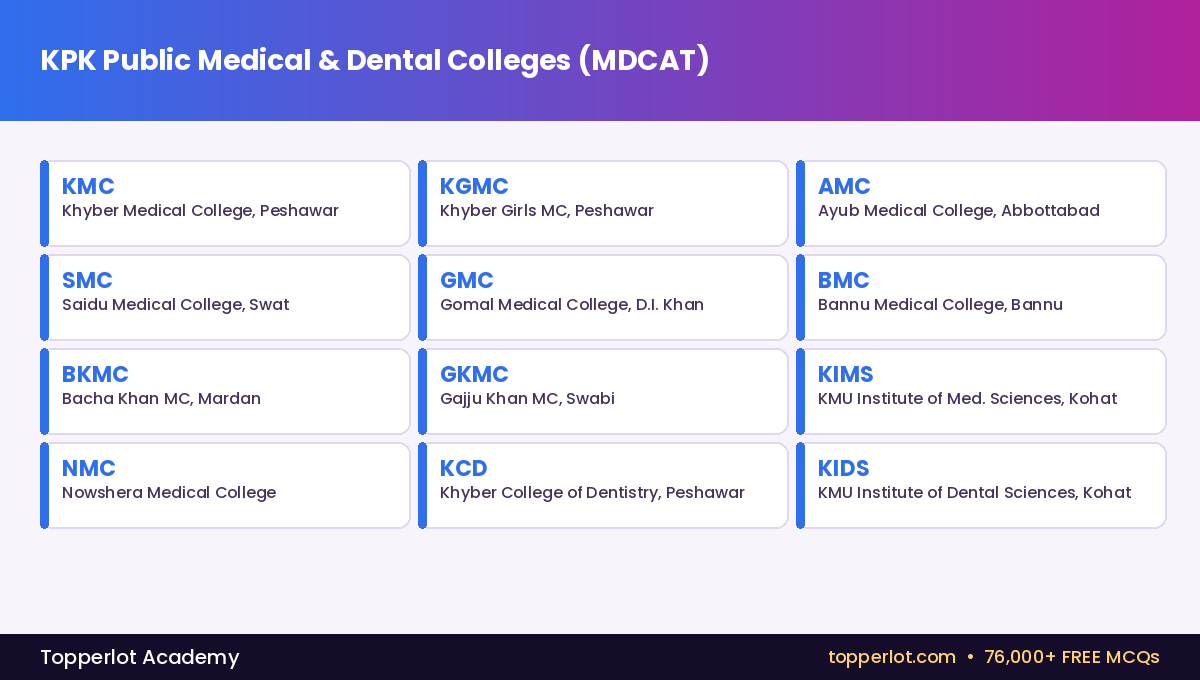
- Bannu Medical College, Bannu (local to you).
- KMU Institute of Medical Sciences and Institute of Dental Sciences, Kohat (relatively close).
- Gomal Medical College, Dera Ismail Khan (also in the south).
- Khyber Medical College and Khyber Girls Medical College, Peshawar.
- Ayub Medical College, Abbottabad.
- Saidu Medical College, Swat.
- Bacha Khan Medical College, Mardan.
- Gajju Khan Medical College, Swabi.
- Nowshera Medical College, Nowshera.
- Khyber College of Dentistry, Peshawar.
Each college has its own seats and its own closing merit each year, and your single aggregate places you on the list for all of them. For a Bannu student, the closer options tend to be Bannu at home, then Kohat and D.I.Khan, though merit, not distance, decides where you land. KPK also has private medical and dental colleges, admitting on the same MDCAT-based merit but on separate lists and at much higher fees.
Merit and aggregate for Bannu students
KPK builds the aggregate from 10% Matric, 40% FSc and 50% MDCAT, with the MDCAT score out of 180. Your aggregate is (Matric % x 0.10) + (FSc % x 0.40) + (MDCAT % x 0.50). Because the MDCAT is half the total and the only part you can still change, it is where your effort has the biggest effect.
To set a target, use the free KPK MDCAT aggregate calculator. Enter your real Matric and FSc percentages, then raise the MDCAT figure until the aggregate reaches the level you need for Bannu Medical College or your chosen college. Closing merit moves every year, so ignore anyone who guarantees a seat at a fixed number. Aim to beat last year’s KMU closing merit for your target by a clear margin, since a higher aggregate never hurts.
What to check before you pay
With fewer academies to choose from in the south, checking quality matters even more. Judge any option, local or online, on what actually moves marks:
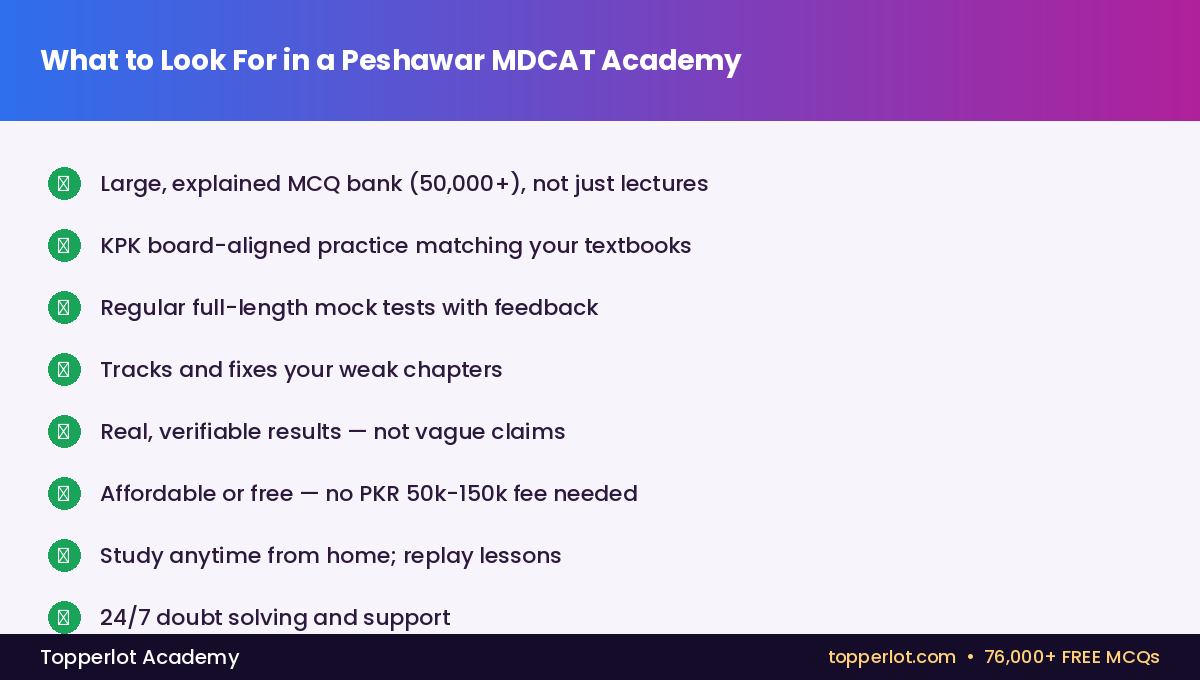
- A large question bank with a clear explanation under each MCQ, not just lectures.
- Full coverage of the PMDC 2026 syllabus, with no missing chapters.
- Practice that matches the KPK textbooks you studied from.
- Regular full-length mock tests that are marked, so you rehearse the real paper and timing.
- A way to see and fix your specific weak chapters.
- Honest, checkable results, not vague claims of countless toppers.
- Reliable access despite load-shedding.
- A fee that reflects what you will actually use.
If a Bannu academy cannot show you steady practice, KPK-aligned drills and real results, its name will not carry you through a competitive list. Ask direct questions before you pay: how many marked mocks, how large is the class, how is your progress tracked. Vague answers usually mean you are paying for a name, not a result. And if the local options are thin, a strong free platform often gives you better practice than the paid one.
Academy or online in the Bannu region
Because the Bannu region has few strong academies, online preparation is often the more reliable choice. Here is an honest comparison:
| Feature | Strong online platform | Typical local academy |
|---|---|---|
| Where you study | Home, any device | Fixed location, daily travel |
| Missed lessons | Replay anytime | Miss class, miss content |
| Question bank | Very large | Often limited |
| Attention | Self-paced with analytics | One teacher, large batch |
| Cost | Free or low | PKR 35,000 to 110,000+ |
A disciplined local academy still suits students who focus better with a routine and a teacher in the room, and if a good one is available in Bannu and you can afford it, use it. But treat it as teaching and still do heavy MCQ practice at home. For a student in a region where strong physical options are limited, a free online platform is not a compromise. It often gives you a larger, better-explained question bank than any local academy, which is exactly what you need to compete on a provincial merit list.
The free option: Topperlot
Topperlot is a complete, genuinely free MDCAT platform, and it is a strong fit for the Bannu region. You get 76,000+ topic-wise MCQs across all five subjects, each with a detailed explanation, plus full subject question banks, updated past papers, a revision test series with national ranking, and board exercises, including the KPK Exercise that matches your provincial textbooks. Everything is free with a free account, and it runs in a phone browser.
The logic is simple. Your score comes from solving MCQs, reviewing mistakes and sitting full tests, all of which you can do from home in Bannu at no cost. Topperlot makes no promise of selection, because no honest platform can. What it gives you is the practice engine. Build accuracy in the Biology and Chemistry banks, work through Physics numericals, secure the easy marks in English and Logical Reasoning, then test yourself with past papers and a weekly revision test. For the wider case, read our guide to the best website for MDCAT preparation.
What preparation costs
A full MDCAT course at a Bannu academy usually runs from about PKR 35,000 to 110,000 or more, and travelling to a bigger city for coaching adds a lot on top. It is fair to ask what the fee actually buys: how many marked mocks, how much personal attention, and whether the question bank is genuinely large and current, since in the south it often is not.
The point to hold onto is that a higher fee does not buy a higher score. A free platform such as Topperlot covers the core practice at no cost, and for a southern student it may well offer a larger and better-explained question bank than the paid local option. So you can prepare entirely free, or pay a local academy for teaching while keeping the heavy practice free at home. For a wider comparison, see our guide on MDCAT coaching fees versus free online.
A six-month plan
A clear plan turns the syllabus into small, doable steps. This one works whether you study at an academy or from home:
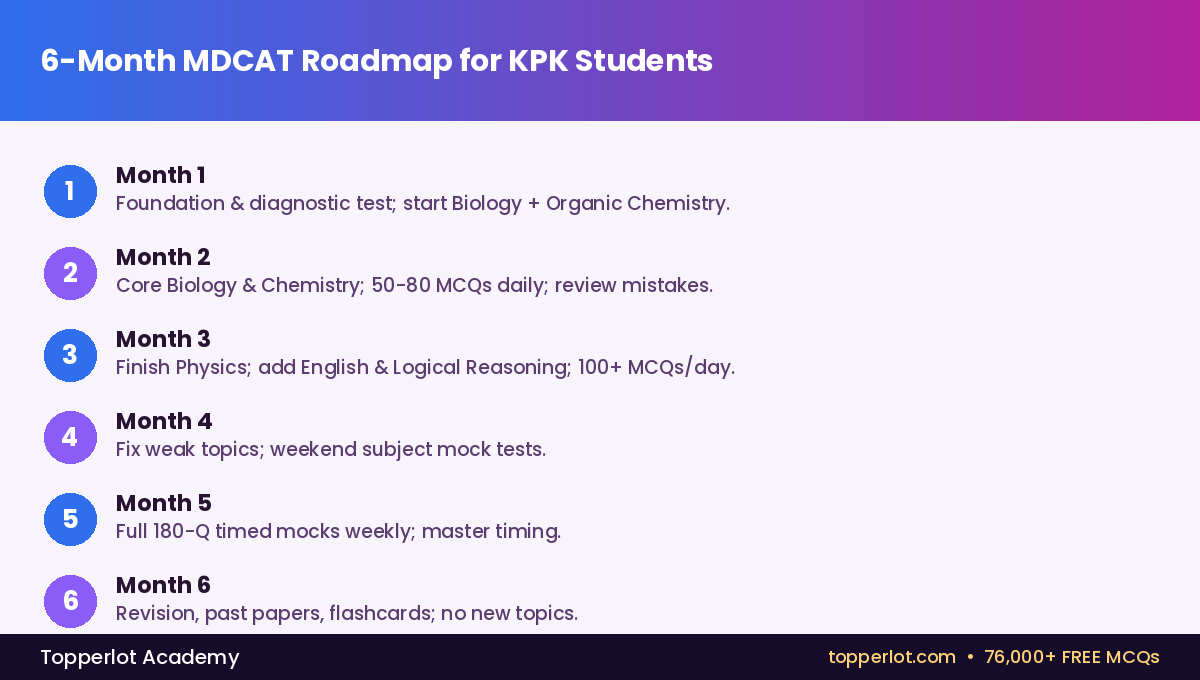
- Month 1: take a diagnostic test, set a routine, and start Biology and Organic Chemistry for real understanding.
- Month 2: cover most of Biology, finish Organic and start Physical Chemistry, and solve 50 to 80 MCQs a day with weekly review.
- Month 3: complete Physics, keep Biology and Chemistry warm with daily sets, and add short English and Logical Reasoning practice.
- Month 4: with the syllabus done, attack your weakest chapters from your mistake record, and sit subject mocks each weekend.
- Month 5: sit full 180-question mocks every weekend under real conditions, and work on pacing at about one minute per question.
- Month 6: stop new topics, revise through summaries and past papers, protect your sleep, and go in calm.
The pattern matters more than the exact months: heavy subjects first, daily practice, regular timed tests, and honest review of every mistake. For the full method, follow our complete MDCAT preparation guide and the KPK study plan.
High-yield topics by subject
Some topics recur far more than others. Once your basics are solid, give these extra attention:
- Biology: cell biology and division, genetics, human physiology (digestive, circulatory, nervous, reproductive, excretory), enzymes, biotechnology and classification. See our high-yield Biology topics guide.
- Chemistry: organic reactions of alcohols, aldehydes, ketones, carboxylic acids and amines, plus equilibrium, electrochemistry, atomic structure and thermochemistry.
- Physics: waves and oscillations, electromagnetic induction, electrostatics, nuclear physics and optics. Drill the formula-based numericals until they feel automatic.
- English: reading comprehension, vocabulary in context, and grammar or sentence correction.
- Logical Reasoning: number series, analogies, pattern recognition and syllogisms.
Do not chase rare topics before you have secured the common ones. Let the weightage and the past papers tell you where the marks are, and spend your time there first.
Studying from Bannu and the southern belt
Online preparation reaches all of the Bannu region equally. A student in Bannu city, or coming in from North Waziristan, Lakki Marwat or Karak, gets the same 76,000+ MCQs, KPK exercises, past papers and mock tests as anyone in Peshawar. For students from the merged districts, where quality academies barely exist, a phone and internet is often the only realistic path to strong preparation, and it is a genuinely good one.
So if you are preparing from Bannu or the surrounding areas, the material is not your problem. With a steady internet habit you can follow the same six-month plan, drill the same KPK exercises, and sit the same weekly mocks as anyone in the province. We also have a local guide for nearby Dera Ismail Khan, another southern district in the same position.
Registration and exam day
The official process is the same wherever in KPK you live. Complete your MDCAT 2026 registration on time, check the eligibility criteria, and download your roll number slip when it is released. Bannu usually has test centres for local and regional candidates, but your exact centre and reporting time appear on the slip, so read it carefully and plan travel in advance. You generally sit in the region of your domicile, so confirm your details on the official notification and read the marking rules before the day.
Mistakes Bannu students make
A few avoidable errors cost Bannu students marks every year. The first is settling for a weak local academy simply because it is nearby, when a free online platform would give better practice. The second is leaning on lectures while doing too little actual MCQ practice. The third is leaving Biology and Chemistry until late and then running out of time. Two more matter: skipping the easy English and Logical Reasoning marks, and never sitting full timed mocks, so pacing fails on the day. Avoid these, follow the plan, and a Bannu Medical College seat, or a place elsewhere in KPK, becomes a realistic goal.
Using your mock scores to climb the merit
Your weekly full-length mock is the best gauge of where you stand, so read it like a coach rather than a scoreboard. Do not just look at the total. Break it down by subject and by chapter. A decent total built on a weak Biology section is fragile, because Biology is 81 of the 180 marks and any competitive KPK aspirant needs to be close to perfect there. Track your subject accuracy over several weeks and watch the direction, not one result.
Then turn the numbers into a plan. Take your best realistic mock score, convert it to a percentage out of 180, and put it into the KPK aggregate calculator with your real Matric and FSc marks. That shows your projected aggregate today and how many more MDCAT marks you need for Bannu Medical College or your chosen college. Every weak chapter a mock exposes is a fixable chance to add those marks. Students who close their weaknesses one by one climb steadily. Those who only watch the total tend to stall.
Key takeaways
The best MDCAT academy in Bannu is the one that gets you practising KPK-aligned MCQs daily, sitting real mocks, and reviewing every mistake, and Bannu students can now get that core practice free online through Topperlot, including the KPK board exercises. Bannu Medical College sits in your city, but you are ranked against the whole province through KMU, so aim high on the MDCAT, study Biology and Chemistry first, and set a concrete target with the KPK aggregate calculator. In the south, where strong academies are few, a free online platform is often your best option.
Start your MDCAT 2026 preparation today
Free access to 76,000+ MCQs, KPK board exercises, past papers and ranked tests, from anywhere in Bannu.
Frequently asked questions
What is the best MDCAT academy in Bannu?
The best MDCAT academy in Bannu is the one that gets you the most KPK-aligned MCQ practice, real marked mocks and honest feedback for your fee. Since the region has few strong academies, many Bannu students now get that core practice free online through Topperlot, which has 76,000+ explained MCQs, KPK board exercises, past papers and ranked tests.
Is there a medical college in Bannu?
Yes. Bannu Medical College (BMC) offers MBBS. Admission is on the KMU provincial merit list, so a strong aggregate keeps a home seat within reach.
Can Bannu students prepare for MDCAT without a physical academy?
Yes, and in the south it is often the better choice. The score comes from solving MCQs, sitting full tests and reviewing mistakes, all of which you can do free from home, often with a larger question bank than local academies offer.
How is the KPK MDCAT aggregate calculated?
KPK uses 10% Matric, 40% FSc and 50% MDCAT, with the MDCAT score out of 180. Use our KPK aggregate calculator to work out yours and set a target MDCAT score for Bannu Medical College or another college.
Which colleges can a Bannu student get into with the MDCAT?
Your KMU aggregate is used for every KPK public college, including Bannu Medical College at home, KMU Institute of Medical Sciences Kohat and Gomal Medical College in the south, plus the Peshawar and Hazara colleges and attached dental colleges.
How much does MDCAT preparation cost in Bannu?
Local academies usually charge around PKR 35,000 to 110,000 or more, and travel to a bigger city adds a lot. A free platform such as Topperlot covers the core practice at no cost, so you can prepare entirely free or use an academy for teaching while practising free at home.
Does Topperlot have KPK board MCQs?
Yes. It includes a dedicated KPK Exercise alongside Federal and Punjab board exercises, so your practice matches the textbooks you studied in KPK, on top of 76,000+ topic-wise MCQs.
Can students from North Waziristan use this too?
Yes. Online preparation reaches the merged districts equally wherever there is a signal. Students from North Waziristan, Lakki Marwat and Karak use the same free MCQs, KPK exercises and mocks as students in Bannu or Peshawar, with no disadvantage on content.
When should a Bannu student start MDCAT preparation?
Ideally six to twelve months before the exam. KPK merit is high, so early, steady practice matters far more than last-minute effort. If you are reading this, the best day to start serious daily practice is today.
Is there negative marking in the MDCAT?
No. There is no negative marking, so attempt every question and never leave one blank. Eliminating options on the ones you are unsure about can add several marks.
Is online MDCAT preparation good enough for a high merit?
Yes, when you use it properly. The largest question banks, past papers and mock tests are online, and the students who score highest are the ones who practised most and reviewed best, whatever platform they used.
Which subjects should a Bannu student focus on first?
Biology first, since it is 81 of the 180 marks, then Chemistry at 45, then Physics at 36. Secure the easy English and Logical Reasoning marks with short regular sessions. Studying by weightage makes every hour count.
Start your MDCAT 2026 preparation today
From Bannu to a doctor’s coat, the road runs through the MDCAT. Create your free Topperlot account, start with the KPK exercises and topic-wise MCQs, set your target with the KPK aggregate calculator, and message the team on WhatsApp at 0316 0541707 if you need help.