
Best Academy for MDCAT in Peshawar 2026: Complete KPK Guide (+ Free Option)

Table of contents
- Why the right MDCAT academy in Peshawar matters
- MDCAT in KPK: what Peshawar students must know
- MDCAT 2026 exam structure
- Subject weightage and MCQ distribution
- KPK medical and dental colleges
- Merit and aggregate targets for KPK
- What makes the best MDCAT academy in Peshawar
- Physical academy vs online preparation
- Topperlot: the free option for Peshawar and KPK
- MDCAT academy fees in Peshawar
- Six-month MDCAT preparation roadmap
- High-yield topics by subject
- Preparing from smaller KPK cities
- Registration and exam logistics
- Common mistakes Peshawar students make
- Frequently asked questions
Every year, thousands of students across Khyber Pakhtunkhwa sit the MDCAT with one goal: a government seat at Khyber Medical College, Ayub Medical College or another top public institution. This guide is built for aspirants from every district of KPK — Peshawar, Mardan, Charsadda, Nowshera, Swabi, Kohat, Hangu, Karak, Bannu, Lakki Marwat, Dera Ismail Khan, Tank, Abbottabad, Mansehra, Haripur, Battagram, Torghar, Kolai-Palas and Upper & Lower Kohistan, Shangla, Swat, Buner, Malakand, Lower Dir, Upper Dir, Central Dir, Upper & Lower Chitral, Bajaur, Mohmand, Khyber, Kurram, Orakzai, North Waziristan and South Waziristan. Wherever you live, the gap between qualifying and missing out almost always comes down to one thing, the quality and quantity of your preparation — and this guide helps you make it as strong as possible, whether you join a physical academy in Peshawar or study free from home.
Why the right MDCAT academy in Peshawar matters
Peshawar is one of the most competitive MDCAT cities in Pakistan. The top KPK government colleges, especially Khyber Medical College (KMC) and Ayub Medical College (AMC), have closed at very high merit in recent years, frequently demanding aggregates that require an MDCAT score around 170 out of 180 or higher for a government MBBS seat. At that level, a handful of marks decides everything, so you simply cannot afford to lose marks to weak or incomplete preparation.
This is exactly where the choice of academy, or study method, becomes the single most important variable in your result. Many physical academies in Peshawar run very large batches, follow fixed schedules, and rely on limited or dated question banks. Students miss classes because of transport, weather or load-shedding, cannot replay a lecture they did not follow, and rarely get personal feedback on their specific weak areas. Every one of those gaps quietly costs marks on exam day. The best academy for MDCAT in Peshawar is therefore not defined by its name or its wall of topper posters, but by how much real, reviewed practice it actually puts in front of you.
The encouraging truth is that the things which build a high MDCAT score, a large explained question bank, board-aligned practice, full mock tests and honest review, are no longer locked behind an expensive classroom. A Peshawar student with a phone and internet can now access all of them, which is why this guide treats a strong free platform as a serious option alongside, or instead of, a paid academy.
MDCAT in KPK: what Peshawar students must know
The MDCAT follows a single national uniform curriculum set by the Pakistan Medical and Dental Council (PMDC), so a student in Peshawar sits the same standard of exam as a student in Lahore or Karachi. In KPK, the test has historically been conducted through the provincial testing arrangement (ETEA), while admissions to public sector medical and dental colleges are managed centrally by Khyber Medical University (KMU) in Peshawar through its online admission portal.
The sequence for a KPK student is clear. You register for and appear in the MDCAT, you receive your score out of 180, and then you apply to KMU during its admission window. KMU calculates each applicant’s aggregate, combines everyone into a single provincial merit list, and offers seats from the highest aggregate downward across all the public colleges. Because it is one central list, your aggregate alone decides which college, if any, you are offered, so preparing to maximise that aggregate is the whole game.
Always confirm the exact conducting body, the MDCAT date, the fee and the current admission policy for 2026 on the official KMU and PMDC sources, because these arrangements can be updated from one year to the next. Understanding the system early removes guesswork and lets you set a realistic, specific target instead of studying blindly.
MDCAT 2026 exam structure
Understanding the exact format is the first step in preparing strategically. The MDCAT is a paper-based multiple choice exam with the following structure:
| Parameter | Detail |
|---|---|
| Total MCQs | 180 |
| Duration | 3 hours (180 minutes) |
| Format | Paper-based MCQs |
| Negative marking | None |
| Medical (MBBS) pass mark | 55% (about 99 / 180) |
| Dental (BDS) pass mark | 50% (about 90 / 180) |
| KMC / AMC government merit (recent years) | Around 170+ / 180 |
One rule matters enormously: there is no negative marking. A blank answer is a guaranteed zero, while even an educated guess has a real chance of being correct. Never leave a single question unanswered, and use elimination on the ones you are unsure about, because that habit alone can add several marks to your final score. Note also that the PMDC pass mark is only the minimum to be eligible; the merit needed for a government seat at a top KPK college is far higher.
Subject weightage and MCQ distribution
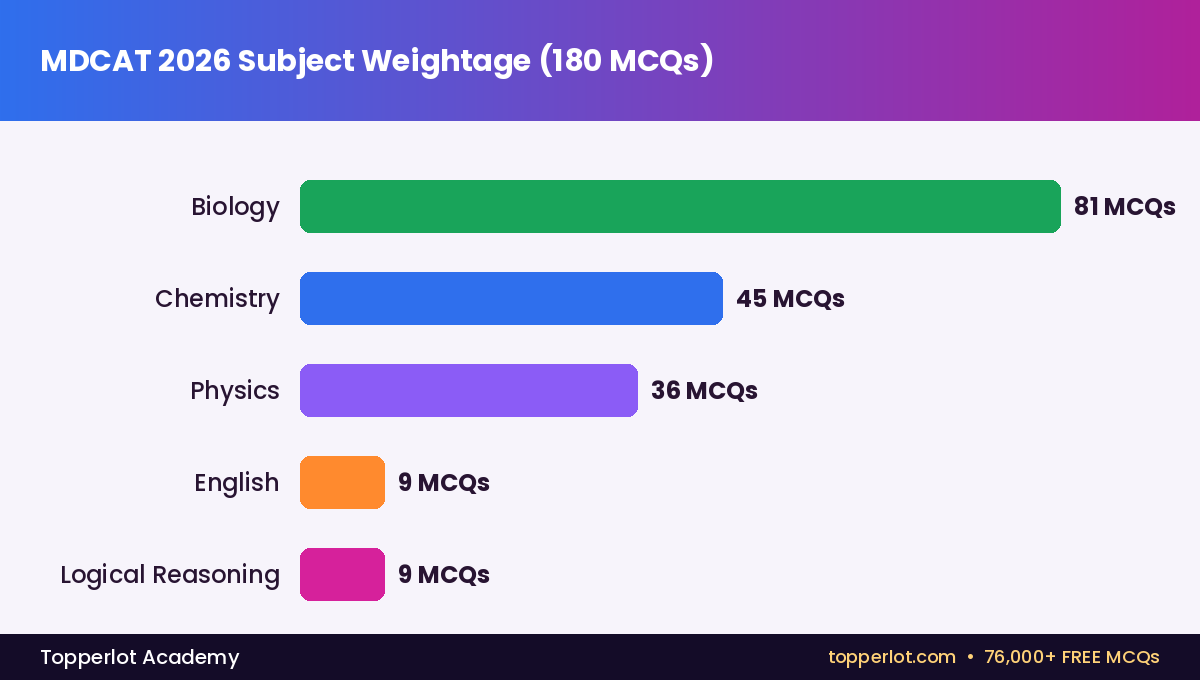
Where you spend your study hours should be decided by where the marks are. The MDCAT is heavily weighted toward Biology, and understanding this distribution is central to smart preparation:
| Subject | MCQs | Share |
|---|---|---|
| Biology | 81 | 45% |
| Chemistry | 45 | 25% |
| Physics | 36 | 20% |
| English | 9 | 5% |
| Logical Reasoning | 9 | 5% |
Biology and Chemistry together make up 126 of the 180 marks, so your performance in these two subjects effectively decides whether you qualify and at what merit position. This does not mean you neglect the others; the 18 marks in English and Logical Reasoning are easy, fast points that top scorers rarely miss. But it does mean your daily plan should give Biology the most time, Chemistry the second most, and never leave the heavy subjects until the end. Practise by weightage in the Biology Question Bank and Chemistry Question Bank first, and the maths of merit starts working in your favour.
KPK medical and dental colleges
Your MDCAT aggregate is the gateway to every public sector medical and dental institution in KPK. Knowing the colleges helps you set a realistic merit target based on where you want to study:
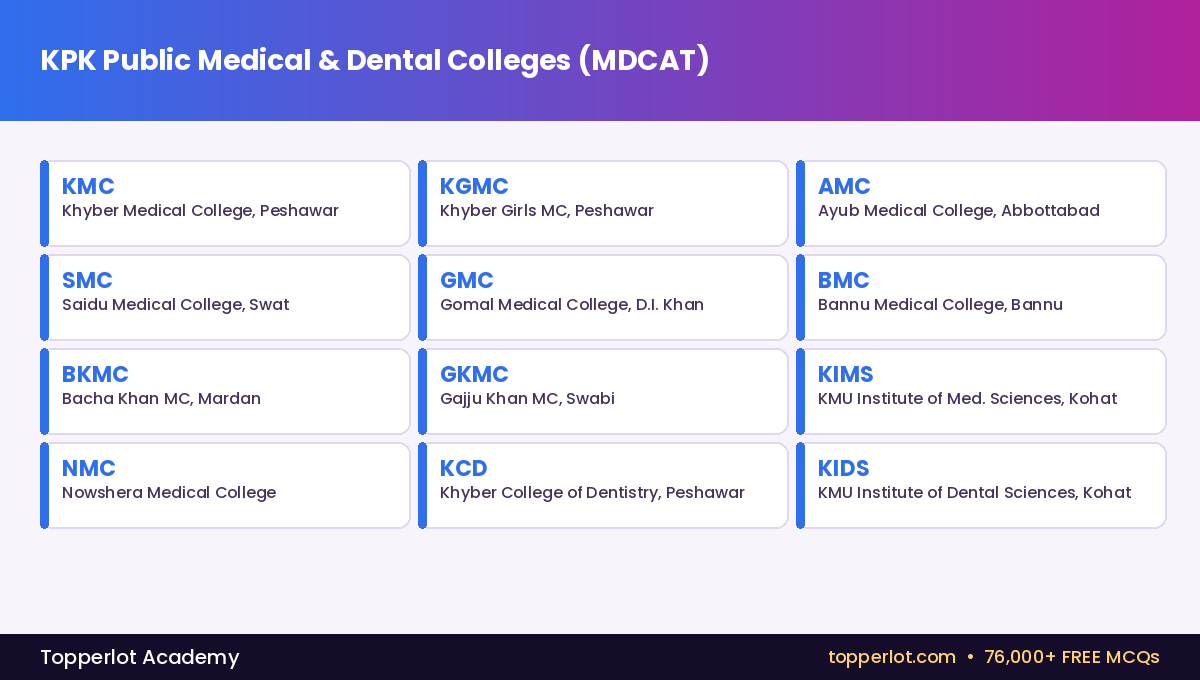
- Khyber Medical College (KMC), Peshawar — MBBS, the highest-merit college in KPK.
- Khyber Girls Medical College (KGMC), Peshawar — MBBS (girls).
- Ayub Medical College (AMC), Abbottabad — MBBS, among the most competitive.
- Saidu Medical College (SMC), Swat — MBBS, and Saidu College of Dentistry for BDS.
- Gomal Medical College (GMC), Dera Ismail Khan — MBBS.
- Bannu Medical College (BMC), Bannu — MBBS.
- Bacha Khan Medical College (BKMC), Mardan — MBBS, with its dental section for BDS.
- Gajju Khan Medical College (GKMC), Swabi — MBBS.
- KMU Institute of Medical Sciences (KIMS), Kohat — MBBS, and KMU Institute of Dental Sciences for BDS.
- Nowshera Medical College (NMC), Nowshera — MBBS.
- Khyber College of Dentistry (KCD), Peshawar — BDS.
Each college has a different number of seats and therefore a different closing merit each year. Your single KMU aggregate places you on the provincial list for all of them at once; you submit your preferences and the central system allocates seats by merit and choice. A higher aggregate widens the set of colleges you can realistically reach, and often decides whether you study near home or travel across the province. Alongside these public colleges, KPK also has private medical and dental colleges, which admit on the same MDCAT-based merit but on separate lists and at much higher fees.
Merit and aggregate targets for KPK
For public sector MBBS and BDS admissions, KPK uses the standard PMDC aggregate weighting: 10% Matric, 40% FSc and 50% MDCAT, with the MDCAT score taken out of 180. In formula form, your aggregate percentage is (Matric % x 0.10) + (FSc % x 0.40) + (MDCAT % x 0.50). Because the MDCAT is worth half of everything and is the only component you can still change, it is where your effort has the greatest effect on your merit.
To set your own target, use the free MDCAT aggregate calculator for KPK, or the national aggregate and merit calculator. Put in your known Matric and FSc percentages, then adjust the MDCAT score until the aggregate reaches the level you need. The honest caution is that closing merit changes every year with applicants, paper difficulty and seat numbers, so do not trust anyone who promises a guaranteed seat at a fixed number. Aim to beat last year’s KMU closing merit for your target college comfortably rather than just scrape it, because a higher aggregate never hurts and always widens your options.
What makes the best MDCAT academy in Peshawar
Whether you are evaluating a physical academy or an online platform, judge it on what actually moves marks, not on marketing. These are the non-negotiable criteria for the best academy for MDCAT in Peshawar:

- A large, explained question bank — ideally tens of thousands of topic-wise, difficulty-graded MCQs with a detailed explanation under each, not just lectures.
- Full syllabus coverage — every topic in the PMDC MDCAT 2026 uniform curriculum, with zero gaps.
- KPK board-aligned practice — drills that match the KPK textbooks you actually studied from.
- Regular full-length mock tests — marked, with feedback, so you rehearse the real paper and timing.
- Weakness tracking — the ability to see and fix your specific weak chapters, not generic revision.
- Honest, verifiable results — real named qualifiers, not vague claims of thousands of toppers.
- Flexibility and access — study anytime, replay lessons, and continue despite load-shedding or transport issues.
- Fair pricing — value for money, since heavy fees do not guarantee a high score.
If an academy in Peshawar cannot clearly show you steady practice, KPK-aligned drills and honest results, its name alone will not carry you through a 170-plus merit race. The students who score highest are simply the ones who practised more questions and reviewed their mistakes better, whatever platform they used.
Physical academy vs online preparation
For many Peshawar students, especially those dealing with traffic, distance, weather and budget, online preparation now matches or beats a physical academy on the factors that decide results. Here is an honest comparison:
| Feature | Strong online platform | Typical physical academy |
|---|---|---|
| Study location | Anywhere in KPK, any device | Fixed location, daily travel |
| Missed lessons | Replay unlimited times | Miss class, miss content |
| Question bank size | Very large (tens of thousands) | Often limited |
| Personal attention | Self-paced, analytics-driven | One teacher, large batch |
| Doubt solving | Anytime | Class hours only |
| Cost | Free or low | PKR 50,000 to 150,000+ |
None of this means a good physical academy has no value; a disciplined classroom with strong teaching suits some students, particularly those who struggle to study alone. The honest point is that the classroom is not required to score well. If you attend an academy, treat it as teaching and still run your own heavy MCQ practice at home, because teaching plus practice beats lectures alone every time. If you cannot afford an academy or live far from a good one, a strong free platform lets you prepare at the same level without the fee.
Topperlot: the free option for Peshawar and KPK
Topperlot is a complete, genuinely free MDCAT platform built with KPK students in mind. You get 76,000+ topic-wise MCQs across all five subjects, each with a detailed explanation, plus full subject question banks, updated past papers, a revision test series with national ranking, and dedicated board exercises, including the KPK Exercise that matches your provincial textbooks. Everything is free with a free account, and it runs smoothly in a phone browser, which matters for students across KPK who study on mobile data.
The reason this works is simple and honest: your MDCAT score comes from solving exam-style MCQs, reviewing your mistakes and taking full tests, and all three can be done from home at no cost. Topperlot does not make guarantees of selection, because no honest platform can; what it provides is the practice engine that actually builds marks. Build accuracy in the Biology and Chemistry banks, sharpen numericals in Physics, secure quick marks in English and Logical Reasoning, then test yourself with past papers and a weekly revision test. For the wider case, see our guide to the best website for MDCAT preparation.
MDCAT academy fees in Peshawar
Physical MDCAT academies in Peshawar typically charge somewhere between PKR 50,000 and 150,000 or more for a full preparation course, and premium or long-duration programmes can cost even more. For many KPK families, that is a significant amount, and it is worth asking exactly what the fee buys: how many marked mock tests, how much personal attention in a large batch, and whether the question bank is genuinely large and current.
The key insight is that a higher fee does not guarantee a higher score. Two students paying very different amounts can end up with very different results simply because one practised and reviewed more. A free platform such as Topperlot covers the core practice at no cost, which means a Peshawar student can either prepare entirely free, or attend an academy for teaching while keeping the heavy practice free at home. For a detailed local breakdown, see our guide on MDCAT coaching fees in Peshawar versus free online.
Six-month MDCAT preparation roadmap
A structured plan calibrated for the competitive KPK merit landscape turns a huge syllabus into a series of manageable steps. Here is a proven six-month roadmap you can follow whether you study at an academy or from home:
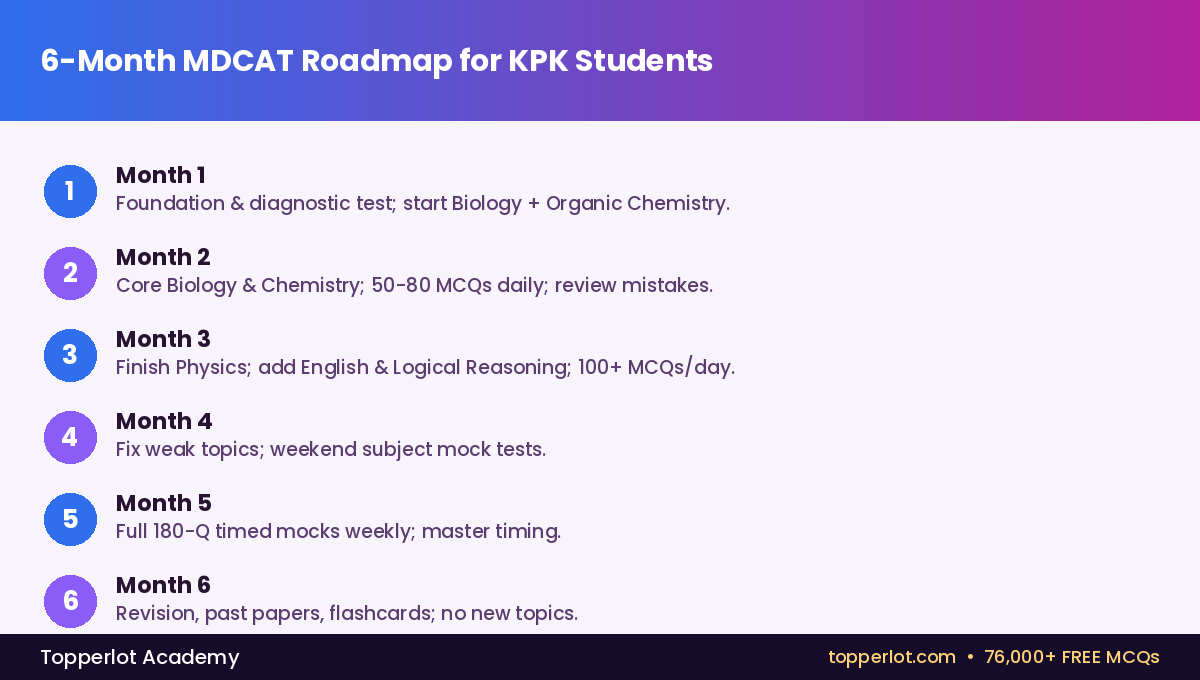
- Month 1 — Foundation and diagnosis. Download the official syllabus, take a diagnostic test to benchmark yourself, set a daily routine, and begin Biology and Organic Chemistry with real understanding rather than memorisation.
- Month 2 — Biology and Chemistry core. Cover the bulk of Biology, finish Organic and start Physical Chemistry, solve 50 to 80 MCQs daily, and review every wrong answer weekly.
- Month 3 — Physics, English and Reasoning. Complete Physics, maintain Biology and Chemistry through daily MCQ sets, and add short daily English and Logical Reasoning practice, aiming for 100+ MCQs a day.
- Month 4 — Gap filling and intensive practice. With the full syllabus covered, use your weak-topic list to attack your weakest chapters systematically, with subject-wise mock tests each weekend.
- Month 5 — Full mocks and time mastery. Sit full 180-question mock tests every weekend under real conditions, and master pacing at roughly one minute per question.
- Month 6 — Revision and consolidation. No new topics; revise through summaries and flashcards, complete past papers, protect your sleep, and walk in confident.
The exact months matter less than the principle: build the heavy subjects first, practise daily, test yourself regularly under time, and always review your mistakes. For the complete method, follow our complete MDCAT preparation guide and the MDCAT study plan for Peshawar students.
High-yield topics by subject
Based on past-paper patterns, certain topics recur heavily and deserve extra attention. Prioritise them once your basics are in place:
- Biology (81 MCQs): cell biology and division, genetics and inheritance, human physiology (digestive, circulatory, nervous, reproductive, excretory), enzymes, biotechnology and kingdom classification. See our high-yield Biology topics guide.
- Chemistry (45 MCQs): organic reactions (alcohols, aldehydes, ketones, carboxylic acids, amines), chemical equilibrium, electrochemistry, atomic structure and thermochemistry.
- Physics (36 MCQs): oscillations and waves, electromagnetic induction, electrostatics, nuclear physics, fluid dynamics and optics; drill the formula-based numericals until they are automatic.
- English (9 MCQs): reading comprehension, vocabulary in context, and grammar or sentence correction.
- Logical Reasoning (9 MCQs): number series, verbal analogies, pattern recognition and syllogisms.
Do not try to master rare topics before you have secured the high-frequency ones. Let the weightage and the past papers tell you where the marks are, and concentrate your effort there first.
Preparing from smaller KPK cities
One of the biggest advantages of online preparation is that it reaches every corner of KPK equally. Students in Swat, Chitral, Dir, Shangla, Mardan, Kohat, Bannu, Abbottabad and the merged districts often have fewer quality physical academies nearby, and travelling to Peshawar for coaching is expensive and impractical. A strong free platform removes that disadvantage entirely: the same 76,000+ MCQs, KPK board exercises, past papers and ranked tests reach a student in a remote valley exactly as they reach one in central Peshawar.
If you are preparing from a smaller KPK city, you are not at a disadvantage on content, only on excuses. With a phone and internet you can follow the same six-month plan, drill the same KPK exercises, and sit the same mock tests as anyone in the city. We have dedicated local guides too, including the best MDCAT academy in Swat, Chitral, Mardan and Abbottabad, all pointing to the same practical truth: consistent, reviewed practice beats location every time.
Registration and exam logistics
The official process is the same wherever in KPK you study. Complete your MDCAT 2026 registration on time, check the eligibility criteria, and download your roll number slip when it is released. Peshawar usually hosts test centres for KPK candidates, but your exact centre and reporting time appear on your slip, so read it carefully and plan your travel in advance. You generally appear in the region of your domicile, so confirm your details on the official notification, and understand the negative marking rule before exam day.
Common mistakes Peshawar students make
A few avoidable errors cost Peshawar students marks and merit every year. The first is choosing an academy for its name or its posters rather than its practice and results. The second is relying on lectures while doing too little actual MCQ practice, when practice and review are what build the score. The third is leaving the heavy subjects, Biology and Chemistry, until late, then running out of time. Two more matter: neglecting the easy English and Logical Reasoning marks, and never sitting full timed mocks, so exam-day stamina and pacing fail. Avoid these, follow the roadmap, and you give yourself the best possible shot at a KMC or AMC seat.
Using your mock scores to climb the KPK merit
Your weekly full-length mock is the single best gauge of where you stand in the Peshawar and KPK merit race, so learn to read it like a coach rather than a judge. After each mock, do not just look at the total; break it down by subject and by chapter. A strong overall score built on a weak Biology section is fragile, because Biology is 81 of the 180 marks and any KMC or AMC aspirant must be near-perfect there. Track your subject-wise accuracy over several weeks and watch the trend, not any single result.
Then turn the numbers into action. Take your best realistic mock score, convert it to a percentage out of 180, and drop it into the KPK aggregate calculator with your real Matric and FSc marks. That shows your projected aggregate today and, crucially, how many more MDCAT marks you need to reach the merit of your target college. Every weak chapter your mocks expose is a concrete, fixable opportunity to add those marks. Students who treat each mock as a to-do list of weaknesses to close climb the KPK merit steadily; those who only chase the total number stall.
Key takeaways
The best academy for MDCAT in Peshawar is the one that gives you the most KPK-aligned practice, real mock tests and honest feedback for your money, and Peshawar and KPK students can now get that core practice free online through Topperlot, including dedicated KPK board exercises and 76,000+ explained MCQs. KMC and AMC demand very high merit (around 170+/180 in recent years), so judge any academy on practice and results rather than its name, study by weightage with Biology and Chemistry first, sit full timed mocks, and set a concrete target with the KPK aggregate calculator.
Start Your MDCAT 2026 Success Journey Today
Access 76,000+ free MCQs, KPK board exercises, past papers and nationwide ranking tests — all in one place, free.
Frequently asked questions
What is the best academy for MDCAT in Peshawar?
The best academy for MDCAT in Peshawar is the one that gives you the most exam-style, KPK-aligned MCQ practice, real mock tests and honest feedback for your fee. Many Peshawar and KPK students now get that core practice free online through Topperlot, which offers 76,000+ explained MCQs, KPK board exercises, past papers and ranked tests.
Can Peshawar students prepare for MDCAT without a physical academy?
Yes. Thousands of KPK students qualify every year through online preparation. The score comes from solving MCQs, taking full tests and reviewing mistakes, all of which can be done free from home. Lectures can be replayed and practice continues despite load-shedding or transport issues.
What MDCAT score is needed for KMC Peshawar?
KMC is the most competitive college in KPK. In recent years its government merit has required an MDCAT score around 170 out of 180 or higher, combined with strong Matric and FSc marks. The PMDC minimum pass is only 55% (about 99/180), but that is far below the merit for a government seat. Confirm current merit on official KMU sources.
How much does MDCAT preparation cost in Peshawar?
Physical academies in Peshawar typically charge PKR 50,000 to 150,000 or more. A strong free platform such as Topperlot covers the core practice at no cost, so you can prepare entirely free, or attend an academy for teaching while keeping the heavy practice free at home.
Does Topperlot have KPK board MCQs?
Yes. Topperlot includes a dedicated KPK Exercise alongside Federal and Punjab board exercises, so your practice matches the textbooks you actually study from in KPK, in addition to 76,000+ topic-wise MCQs across all five subjects.
Which KPK colleges accept the MDCAT score?
All KPK public sector institutions, including Khyber Medical College, Khyber Girls Medical College, Ayub Medical College, Saidu Medical College, Gomal Medical College, Bannu Medical College, Bacha Khan Medical College, Gajju Khan Medical College, KMU Institute of Medical Sciences, Nowshera Medical College and Khyber College of Dentistry, admit on the KMU merit list built from your aggregate.
How is the KPK MDCAT aggregate calculated?
KPK uses 10% Matric, 40% FSc and 50% MDCAT, with the MDCAT score out of 180. Use our KPK aggregate calculator to compute yours instantly and set a target MDCAT score for your chosen college.
When should a Peshawar student start MDCAT preparation?
Ideally six to twelve months before the exam. Given the very high KPK merit, early, consistent preparation matters far more than last-minute cramming. If you are reading this, the best time to start serious daily practice is now.
Is there negative marking in MDCAT 2026?
No. There is no negative marking, so you should attempt every question and never leave one blank. Using elimination on uncertain MCQs can add several marks to your score.
Is online MDCAT preparation better than a physical academy in Peshawar?
For many Peshawar students, online preparation matches or beats a physical academy on results, flexibility and cost, because it offers unlimited replays, a far larger question bank, self-paced practice and much lower cost. A good academy still helps students who need a classroom, but the classroom is not required to score well.
Can students in Swat, Chitral or Dir prepare for MDCAT online?
Yes. Online preparation reaches every part of KPK equally. Students in Swat, Chitral, Dir, Shangla and the merged districts use the same free MCQs, KPK exercises, past papers and mock tests as students in Peshawar, with no disadvantage on content.
How many hours a day should I study for MDCAT in KPK?
Quality and consistency matter more than a fixed number, but a serious KPK aspirant typically studies several focused hours daily, weighted toward Biology and Chemistry, with daily MCQ practice and weekly full mocks. Steady daily effort over months beats occasional long sessions.
Start Your MDCAT 2026 Success Journey Today
From Peshawar to a doctor’s coat, the road runs through the MDCAT. Create your free Topperlot account, start with the KPK exercises and topic-wise MCQs today, set your target with the KPK aggregate calculator, and message our team on WhatsApp at 0316 0541707 if you need help.