
Table of contents
- What Makes a Chemistry Topic High-Yield for MDCAT?
- Which Chapters Carry the Most Weight in MDCAT Chemistry?
- Organic Chemistry Topics You Must Master for MDCAT 2026
- Physical Chemistry: Where to Invest Your Problem-Solving Hours
- Inorganic Chemistry: The Quick-Scoring Block You Should Not Skip
- A 6-Week High-Yield Chemistry Study Plan for MDCAT 2026
- How to Practice High-Yield Topics Without Wasting Time
- Frequently asked questions
What Makes a Chemistry Topic High-Yield for MDCAT?
A high-yield topic is one that appears year after year with significant marks attached. In MDCAT Chemistry, the paper draws from the FSc Part 1 and Part 2 syllabus as prescribed by the admitting universities. The University of Health Sciences model paper and past papers from the last five years reveal a clear pattern. Certain chapters give you far more marks per hour of study than others.
The logic is simple. The MDCAT has a fixed number of Chemistry questions, usually 58 to 60. Topics like Chemical Bonding, which carry multiple conceptual and numerical MCQs, will always be tested. Meanwhile, a chapter like Environmental Chemistry might give you one question or none. Studying everything equally is a planning mistake. If your prep window is tightening, you need to allocate hours based on historical weightage, not the textbook table of contents.
The pattern also shows that examiners love hybrid questions that combine two concepts. For example, a question on the boiling point of alcohols versus ethers tests your organic functional group knowledge and your understanding of hydrogen bonding from the bonding chapter. When you know the high-yield topics, you also start spotting these cross-chapter links.
- A high-yield chapter typically contributes four to seven MCQs in every MDCAT sitting.
- Organic Chemistry as a whole often accounts for 18 to 22 questions, making it the single biggest block.
- Chapters that include both theory and numerical problems, like Thermochemistry and Electrochemistry, are double threats because they test two skills at once.
Which Chapters Carry the Most Weight in MDCAT Chemistry?
Based on the UHS pattern and PMC syllabi from recent cycles, the following chapters consistently offer the highest return on your time. This breakdown assumes the 2026 test will maintain the same relative distribution. The marks may shift slightly, but the heavy hitters will remain the same.
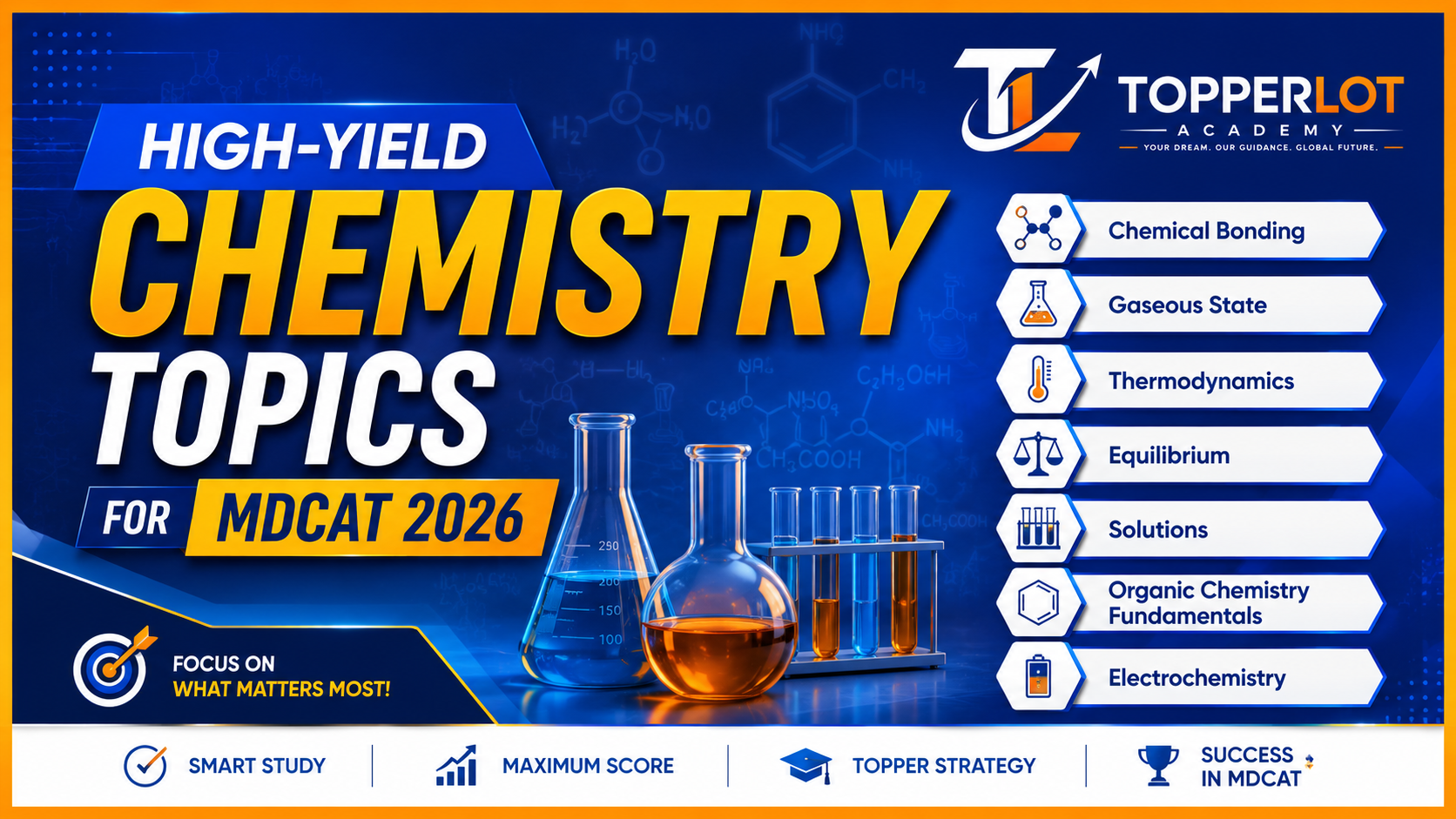
Organic Chemistry is the undisputed king. Within it, hydrocarbons, alkyl halides, alcohols and phenols, aldehydes and ketones, and carboxylic acids form the core. Questions often test reaction mechanisms, reagent-specific outcomes, acidity comparisons, and distinguishing tests. Inorganic Chemistry contributes through the s-block, p-block, and transition elements, with periodic trends and compound properties being examiner favourites. Physical Chemistry rounds out the high-weightage list with atomic structure, chemical bonding, thermochemistry, equilibrium, and electrochemistry.
A surprising number of students ignore the p-block elements thinking it is just memorization. But those six to eight questions are often straightforward fact-based marks that you can collect quickly. The same goes for the d- and f-block chapter, though its weight is slightly lower. The takeaway is this. Organic and physical chemistry should get roughly 70 percent of your total Chemistry study time, with inorganic getting the remaining 30 percent.
- Organic Chemistry (FSc Part 2, chapters 3 to 11): roughly 18 to 22 MCQs.
- Chemical Bonding (Chapter 6, FSc Part 1): 4 to 6 MCQs, with hybridization and molecular orbital theory frequently tested.
- Thermochemistry (Chapter 7, FSc Part 1): 3 to 5 MCQs, mostly numerical.
- Electrochemistry (Chapter 10, FSc Part 1): 3 to 5 MCQs, including electrolytic cell calculations.
- s- and p-Block Elements (Chapters 2 and 3, FSc Part 2): 5 to 8 MCQs combined.
Organic Chemistry Topics You Must Master for MDCAT 2026
Organic Chemistry intimidates many pre-med students, but it is the most pattern-based section of the Chemistry paper. Once you learn a handful of reaction types and the logic of electron flow, the MCQs become predictable.
Start with hydrocarbons. The conversions between alkanes, alkenes, and alkynes, along with their preparation methods and physical properties, form the foundation. Markovnikov and anti-Markovnikov additions, ozonolysis, and the acidic nature of terminal alkynes are repeated every year. Next, alkyl halides and the distinction between SN1 and SN2 mechanisms. Examiners love questions on the effect of solvent, substrate structure, and nucleophile strength on the reaction pathway. You should be able to draw a quick table in your mind that compares the two mechanisms on at least six points.
Alcohols and phenols are high-yield because they bridge organic and bonding concepts. The acidity of phenol versus ethanol, the Lucas test, and the reactions of alcohols with sodium metal, PCl5, and oxidizing agents are classic MCQs. Aldehydes and ketones follow next. Aldol condensation, Cannizzaro reaction, and the use of Fehling's solution and Tollen's reagent as distinguishing tests are golden topics. Carboxylic acid derivatives, especially the reactivity order of acid chlorides, amides, and esters, appear frequently as a single direct MCQ.
Do not ignore the chapter on amines. Questions on basicity order, diazotization, and the carbylamine test are quick marks. Biochemistry, though often listed separately, overlaps with organic. The structures of glucose and fructose, types of lipids, and the nature of amino acids appear in a straightforward manner.
- Prepare a single A4 sheet with all named reactions from the entire organic syllabus. Update it as you solve past papers. Read it every morning.
- For mechanisms, draw the curved arrows yourself. Do not just stare at the book. Muscle memory helps.
- Practice distinguishing test MCQs in a table format. "Test: Tollen's reagent; Aldehyde: positive; Ketone: negative." This saves time during the exam.
Physical Chemistry: Where to Invest Your Problem-Solving Hours
Physical Chemistry gives you the chance to score full marks on numerical MCQs because they are objective. Either you get the correct answer or you do not, and the steps are repeatable.
Chemical bonding is the most conceptual chapter. Hybridization geometries, bond angles, dipole moments, and the molecular orbital theory electronic configurations for diatomic molecules are staples. Make sure you can predict the shape of a molecule like SF6 or ClF3 using VSEPR theory within ten seconds. Thermochemistry is pure calculation heaven. The Hess's law problems, bond energy calculations, and the relation between enthalpy of combustion and formation are high-probability numerical MCQs. Always check if the question wants the answer in kJ or kJ per mole, because the options often include both to trick you.
Electrochemistry tests your numerical ability and conceptual clarity together. Faraday's laws, the Nernst equation, and the calculation of cell potential are common. Also, the difference between electrolytic and galvanic cells, the working of the fuel cell, and the lead accumulator are fact-based questions that surface repeatedly. Chemical equilibrium is another concept-heavy area. The Le Chatelier principle, the effect of temperature, pressure, and catalyst on equilibrium position, and the calculation of Kc and Kp values are essential. A lot of students lose marks on the Kp formula because they forget to use partial pressures correctly.
Atomic structure, while fundamental, has low hanging fruit in the form of quantum numbers, the Heisenberg uncertainty principle, and spectral lines. Avoid getting bogged down in the historical models. Focus on the MCQs that ask "which set of quantum numbers is not possible" and "calculate the wavelength of an electron."
- For every physical chemistry formula, make a small flashcard with the formula on one side and a one-line example on the other.
- Solve at least 15 numerical MCQs per chapter before moving to the next. Speed comes only through repetition.
- Pay attention to units. Convert atm to torr, Celsius to Kelvin, and grams to moles before plugging numbers.
Inorganic Chemistry: The Quick-Scoring Block You Should Not Skip
Inorganic chapters do not require the deep problem-solving that organic or physical chemistry demand. They reward those who read the textbook lines carefully and revisit the material often.
The s-block elements chapter is short and sweet. Trends in ionization energy, hydration energy, flame colours of alkali and alkaline earth metals, and the anomalous behaviour of lithium and beryllium are repeated. The p-block elements chapter is longer but equally rewarding. Group-wise properties of halogens, the oxidizing power trend, the unique behaviour of fluorine, and the structures of oxyacids like HNO3 and H2SO4 are exam favourites. Questions on bleaching powder, the Haber process, and the contact process for sulphuric acid appear with minor variations in wording.
Transition elements (d- and f-block) usually contribute three to four MCQs. The definition of a transition element, the colour and magnetic properties of compounds, the alloy compositions, and the catalytic activity are standard. A single question on the lanthanide contraction and its consequences is almost guaranteed. The chapter on periodicity overlaps heavily with atomic structure, so study them together. Trends like atomic radius, electronegativity, and electron affinity across periods and down groups are always tested.
- Read the NCERT or Punjab textbook boxes. The "Do You Know" and "Interesting Fact" boxes often become MCQ one-liners.
- Memorize the exceptional electron configurations of chromium and copper. They appear every single year.
- For p-block, create mnemonics for the order of properties within a group. For example, "FIRST ClBrI" for the decreasing oxidizing power of halogens: Fluorine, Iodine… (check the real order: F > Cl > Br > I, but the mnemonic can be "Fast Cars Bring Instant" — whatever sticks).
A 6-Week High-Yield Chemistry Study Plan for MDCAT 2026
A plan that is not time-bound is a wish list. Here is a week-by-week breakdown that prioritizes high-yield chapters first, so if you run out of time, the most important material is already covered. Adjust the weeks based on your exam date, but always start with organic and bonding.
Week 1. Organic chemistry foundations: hydrocarbons (alkanes, alkenes, alkynes) and alkyl halides. Focus on reaction mechanisms and conversion charts. Solve 30 MCQs daily.
Week 2. Oxygen-containing organic compounds: alcohols, phenols, aldehydes, ketones, and carboxylic acids. Learn all distinguishing tests.
Week 3. Physical chemistry heavy hitters: chemical bonding and thermochemistry. Finish the full chapter MCQs from the last five years.
Week 4. Electrochemistry, equilibrium, and atomic structure. Build speed on numericals. Use a stopwatch.
Week 5. Inorganic chemistry: s-block, p-block, and periodicity. Make your own tables and drill them daily.
Week 6. Transition elements, remaining organic chapters (amines, biochemistry), and full-length section tests. This week is for plugging gaps and reviewing your A4 reaction sheet.
If you are also working on your university applications while studying, it can stretch your schedule thin. At Border and Bridges, located in Johar Town, Lahore, we help pre-med students map their MBBS admissions abroad so they can plan their MDCAT prep around university deadlines without the anxiety of the unknown.
- Every Sunday, solve one full Chemistry section test from a previous year's paper under timed conditions. Do not skip this. It builds exam temperament.
- Keep an error log. Every wrong MCQ goes into it with the correct concept written in one line.
- If a chapter is taking longer than planned, move on. Return to it during Week 6. Momentum matters more than perfect completion.
How to Practice High-Yield Topics Without Wasting Time
How you practice decides whether your six weeks turn into a high score or a blur of forgotten facts. Solve MCQs with a timer. When you solve a batch of 20 organic MCQs, give yourself 22 minutes. The pressure will train your brain to retrieve information faster. Initially, you will get more wrong answers. That is good. Errors under time pressure show you exactly where your conceptual gaps are, and you can patch them immediately.
Use the elimination method aggressively. In many MDCAT Chemistry MCQs, you can eliminate two options based on a single incorrect unit or a wrong functional group. This skill is especially useful in Physical Chemistry, where you can often spot a magnitude error without fully solving the problem. But do not let elimination replace conceptual clarity. After the test, go back and solve every question as if it were a short-answer question.
When our students at Border and Bridges are preparing for MDCAT while also securing admission letters from medical universities abroad, they often practice with a dual-track mindset. The certainty of a conditional admission serves as a safety net that paradoxically reduces pressure and improves their MCQ performance. Our office in Johar Town, Lahore, verified by SECP, FBR, ICEF, and the British Council, provides free counselling to help you align your test prep with your long-term medical education goals.
- Do topic-wise MCQ banks first, then mix topics. The real MDCAT does not group questions by chapter.
- Every time you solve a numerical, circle the final answer and check if it makes physical sense. A delta H of 2000 kJ for a simple combustion is probably wrong.
- Record a 5-minute voice note after each study session summarizing what you learned. Play it back the next day while having breakfast.
Frequently asked questions
How many Chemistry MCQs are there in MDCAT 2026?
The standard MDCAT format includes 58 to 60 Chemistry questions, though the exact number depends on the final 2026 paper pattern issued by the admitting university. Typically, Chemistry holds the same weight as Biology, making it impossible to ignore if you want a competitive aggregate.
Is MDCAT Chemistry harder than FSc board exams?
Many students find MDCAT Chemistry more conceptual and time-sensitive than board exams. The MCQs often combine two concepts in one question. However, the syllabus is exactly the FSc textbook, so mastering the textbook and past papers is enough to score well.
Which is more important for MDCAT, Organic or Physical Chemistry?
Organic Chemistry has a higher number of questions, so it carries slightly more weightage. Physical Chemistry numericals, however, are often make-or-break because students either score full marks or lose them entirely. Balance both, but start with organic if time is short.
Can I skip the s-block and p-block chapters and still get a good score?
You can, but it is a risky decision. The s-block and p-block chapters combined can give you five to eight relatively easy MCQs. Skipping them means you must score perfectly from other chapters, which adds unnecessary pressure.
What is the best source for MDCAT Chemistry MCQs?
The UHS past papers from the last decade are the single most authentic source. After that, the exercise questions at the back of the Punjab textbook and reputable MCQ books like the one by KIPS or STEP offer good practice. Always prioritize past-paper patterns.
How can I memorize organic chemistry reactions permanently?
Understand the electron flow behind each reaction instead of memorizing text. Draw the mechanism ten times while explaining it out loud. Then solve 20 related MCQs immediately. The combination of writing, speaking, and applying moves information from short-term to long-term memory.
I am applying for MBBS abroad. Does a high Chemistry score help in admission?
Yes, a strong MDCAT or equivalent entry test score, including Chemistry, strengthens your profile when applying to medical universities in countries like China, Uzbekistan, or Russia. At Border and Bridges in Johar Town, Lahore, we can help you understand how your test score aligns with admission requirements at approved universities abroad.
Ready to take the next step?
A well-planned Chemistry prep opens doors, but knowing where you are heading keeps you studying. If you are considering an MBBS degree abroad alongside your MDCAT journey, visit Border and Bridges in Johar Town, Lahore. We are verified by SECP, FBR, ICEF, and the British Council, and our free first consultation will help you connect your test-day performance to a medical seat overseas. Book your slot now.