
MDCAT Last 30 Days Plan 2026: Final Month Strategy to Boost Your Score

Table of contents
- Why the last 30 days matter
- The mindset for the final month
- Week 1: consolidate the heavy subjects
- Week 2: full mocks and weak areas
- Week 3: past papers and speed
- Week 4: taper and revise
- Your daily structure this month
- Revise with active recall
- How to analyse your mocks
- Focus on high-yield topics
- The last seven days
- The last 48 hours
- What not to do
- Frequently asked questions
The final month is where MDCAT scores are made or lost, and not for the reason most students think. By now the syllabus should be covered. What decides your result now is how well you consolidate that knowledge, how sharp your exam-day pacing is, and how calmly you walk into the hall. Panic and cramming new topics tend to lower scores in the last month. A clear plan tends to raise them. Here is that plan.
Why the last 30 days matter
Everything you learned over the previous months is sitting in your memory in a rough, half-organised state. The last 30 days are when you sharpen it into something you can recall instantly under pressure. This is when scattered knowledge becomes reliable marks, when your pacing gets trained by repeated mocks, and when your weak chapters get one last honest fix. Skip this phase, or waste it on panic, and months of earlier work never fully pay off.
There is also a nerves factor. A student who spends the final month sitting mocks and revising calmly walks in confident, because the exam feels familiar. A student who spends it frantically opening new chapters walks in anxious and scattered. Since the MDCAT rewards a steady, paced attempt across 180 questions, your state of mind on the day matters, and the final month is where you build it.
The mindset for the final month
Adopt one rule for the next 30 days: consolidate, do not expand. This is not the time to start a brand new difficult chapter from scratch, because a half-learned topic added now brings more confusion than marks. If there is a small gap in a high-yield area, close it quickly, but your main job is to strengthen and revise what you already have.
The second rule is to make practice the centre of everything. In the final month, solving and reviewing questions should take up more of your time than reading. You are past the learning phase and into the performance phase, so train like you will play: timed, under pressure, reviewing every mistake. Reading notes should support that practice, not replace it.
Week 1: consolidate the heavy subjects
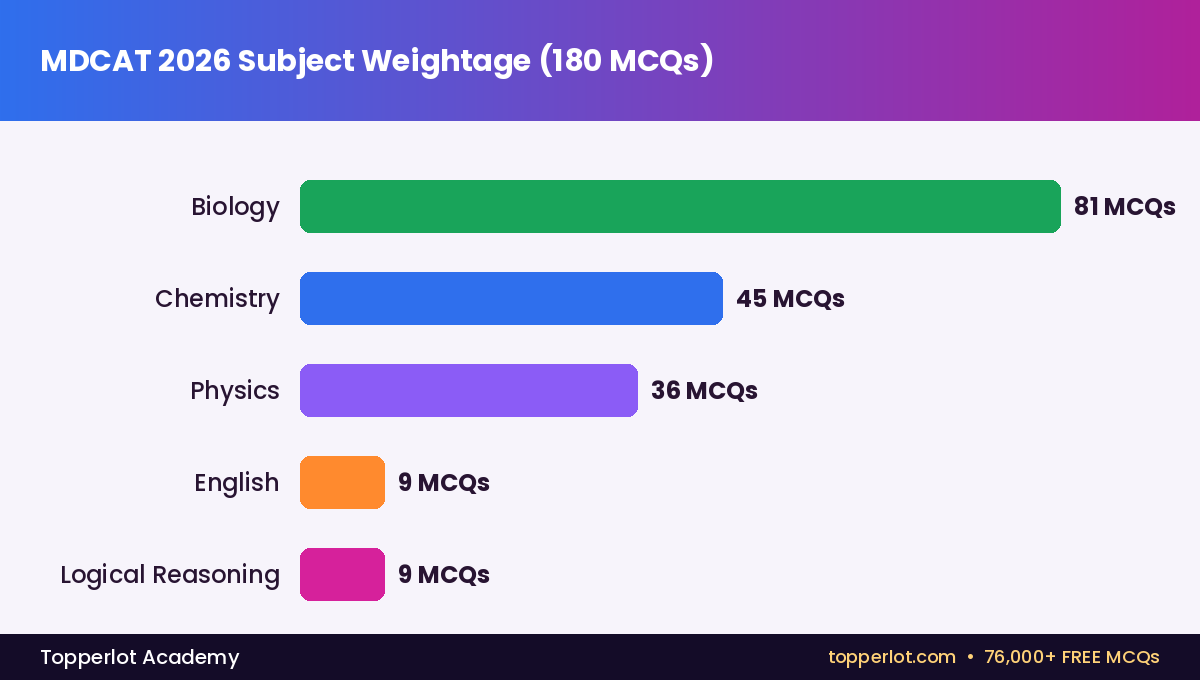
Start with the subjects that carry the paper. Biology and Chemistry are 126 of the 180 marks, so the first week goes mostly to them. Revise chapter by chapter, but revise actively: read a topic quickly to refresh it, then immediately solve a set of MCQs on it, then review your mistakes. Do not just reread notes and feel productive.
Work through the high-yield chapters first, since they give the most marks per hour: cell biology, genetics, human physiology, and Organic Chemistry reactions. Use the Biology Question Bank and Chemistry Question Bank to drill each chapter as you revise it, and keep a running list of the topics you keep getting wrong.
Week 2: full mocks and weak areas
By the second week, add full-length mock tests to your routine while continuing subject revision. Sit at least two or three complete 180-question mocks this week under real conditions: the same time limit, no interruptions, no notes. The point is not only the score. It is to train your stamina for three hours and your pacing at one minute per question.
Use the mock results to steer your revision. Whatever chapters cost you the most marks become your priority for the rest of the week. Finish Physics revision here too, drilling the recurring numerical types until they feel automatic. Build your mocks from the Revision Test Series and reinforce Physics in the Physics Question Bank.
Week 3: past papers and speed
The third week belongs to past papers and speed. Real past questions show you the exact style and difficulty the examiners use, so working through several years of papers is the closest thing to seeing the real exam early. Solve them under time, then review every question you missed and every one you guessed correctly, because a lucky guess is still a weak spot.
Keep sitting full mocks this week too, aiming to raise both your accuracy and your speed. Secure the easy 18 marks in English and Logical Reasoning with short daily sets, since these are quick, certain points that students lose only to carelessness. Use the MDCAT Yearly Past Papers, the English and Logical Reasoning sections, and the KPK, Federal and Punjab board exercises to match your board style.
Week 4: taper and revise
The final week is about tapering, not cramming. Stop trying to cover ground and instead revise through your own summaries, formula sheets and the list of mistakes you have been keeping all month. Do a lighter mock or two to keep your rhythm, but reduce the intensity so you arrive rested rather than burned out. A tired brain underperforms, so the goal this week is a sharp, calm mind.
Trust your preparation. This is not the week to panic-learn a new topic, which only shakes your confidence. Go over your strongest and your high-yield areas so they are fresh, protect your sleep, and keep your routine steady. The student who rests and revises calmly in the last week almost always beats the one who crams through the night.
Your daily structure this month
A repeatable daily shape keeps the final month productive without exhausting you:
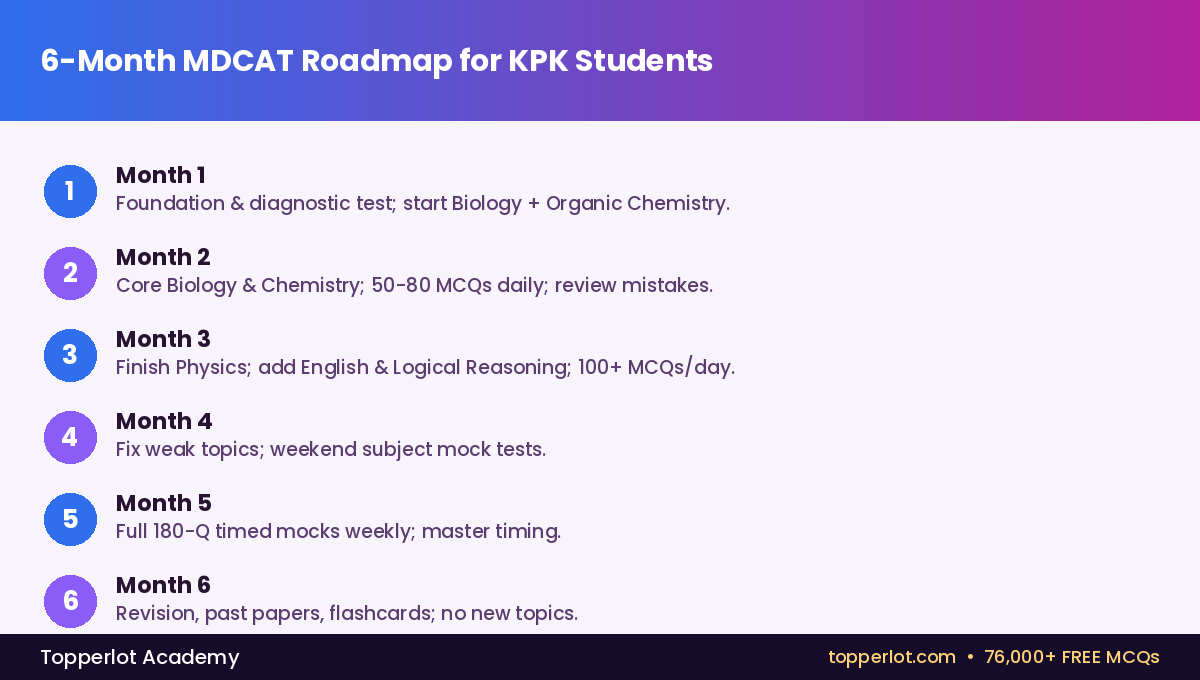
- Morning: revise a heavy-subject chapter actively, reading then solving MCQs on it.
- Midday: drill MCQs on that chapter plus an older one, and review every mistake.
- Afternoon: past papers or a full mock on your mock days, under timed conditions.
- Evening: short English and Logical Reasoning practice, then review the day and update your mistake list.
Keep the blocks focused and your phone away during them, since concentration matters most now. If your focus wanders in these final weeks, read our guide on how to stay focused and remove distractions, and pace your day with our MDCAT time management guide.
Revise with active recall
How you revise in the last month matters as much as what you revise. Passive rereading feels comfortable and teaches little, because your brain recognises the words without truly recalling the content. Active recall is the opposite and far stronger: close the book and try to retrieve the information from memory, then check. Solving MCQs is a natural form of active recall, which is another reason practice should dominate this month.
Space your revision too. Revisit a chapter, then return to it a few days later, then again near the exam. This spacing moves knowledge into durable memory far better than reading it once for a long time. A running mistake list revised every few days is one of the most powerful tools you have in the final 30 days.
How to analyse your mocks
A mock test you do not analyse is half wasted. After each full mock, do not just note the total. Break it down by subject and by chapter to see exactly where the marks leaked. A good total hiding a weak Biology section is fragile, because Biology is the largest block of the paper. Track your subject accuracy across mocks and watch whether it is rising.
Then convert your best realistic mock score to a percentage out of 180 and put it into the KPK aggregate calculator with your real Matric and FSc marks. That shows your projected aggregate right now and how many more MDCAT marks you need for your target college. Each weak chapter a mock exposes is a concrete, fixable chance to add those marks in the days you have left.
Focus on high-yield topics
With limited days, spend them where the marks are densest. Do not chase rare, difficult topics you have never understood while high-yield chapters remain shaky. Prioritise the areas that appear most often:
- Biology: cell biology and division, genetics, human physiology, enzymes and biotechnology. See our high-yield Biology topics guide.
- Chemistry: Organic reactions, equilibrium, electrochemistry and atomic structure.
- Physics: waves, electromagnetism, electrostatics and the common numerical types.
- English and Logical Reasoning: steady short practice to lock in the easy 18 marks.
Securing your high-yield chapters completely is worth more than half-learning a rare topic. Let the past papers confirm where the marks sit and revise there first.
The last seven days
In the final week, shift fully into revision and rest. Go through your summaries and mistake list, sit one or two lighter mocks to hold your rhythm, and stop adding anything new. Fix your sleep schedule now so your body is used to being alert at the exam time, rather than trying to reset it the night before. Keep your routine calm and predictable, because a settled mind recalls more.
Prepare the practical things too, so nothing rattles you on the day. Know your exam centre and route, keep your roll number slip and required documents ready, and reread the marking rules and paper pattern so there are no surprises. Confidence in the last week comes from being organised, not from one more late-night chapter.
The last 48 hours
The final two days are for light revision and calm, nothing heavy. Skim your formula sheets and summaries, glance over your mistake list one last time, and then let your mind rest. Do not attempt a full exhausting mock the day before or try to cram a difficult topic, since both drain the energy you need for the real paper. Eat normally, hydrate, and sleep properly the night before.
Plan the morning of the exam in advance. Wake with enough time, eat a steady breakfast, and reach the centre early so you are not rushing. Go in with your simple exam-day plan: start with your strongest section, keep to the one-minute rule, never leave a question blank since there is no negative marking, and check your answer sheet at the end. You have done the work. The last 48 hours are about arriving fresh and using it.
What not to do
Some final-month habits actively lower scores. Do not start new difficult topics from scratch, because they add confusion, not marks. Do not abandon practice to only reread notes, since passive revision does not build recall. Do not pull all-nighters, which trade sharpness for a false sense of effort. Two more to avoid: comparing yourself anxiously to others instead of working your own plan, and skipping mock analysis so the same mistakes repeat. Steer clear of these, follow the weekly plan, and your last 30 days will lift your score rather than shake it.
Key takeaways
The MDCAT last 30 days plan is about consolidation, not new learning. Spend week one revising Biology and Chemistry actively, week two on full mocks and weak areas, week three on past papers and speed, and the final week tapering and resting. Make practice the centre, revise with active recall, analyse every mock and check your projected merit with the KPK aggregate calculator. Protect your sleep, focus on high-yield topics, and walk in calm with a clear exam-day plan.
Make your final month count
Sit full mocks and drill 76,000+ explained MCQs and past papers free on Topperlot.
Frequently asked questions
What should I do in the last 30 days before the MDCAT?
Consolidate rather than learn new chapters. Revise Biology and Chemistry actively in week one, add full mocks and fix weak areas in week two, drill past papers and speed in week three, and taper and rest in the final week. Make MCQ practice the centre of every day.
Should I learn new topics in the last month?
No, as a rule. A half-learned topic added late brings more confusion than marks. Close a small gap in a high-yield area quickly if needed, but focus mainly on strengthening and revising what you already know.
How many mock tests should I take in the last 30 days?
Build up to several full 180-question mocks across the month, with at least two or three in week two and more in week three. Sit each under real timed conditions and analyse it carefully afterwards.
How do I revise effectively in the final month?
Use active recall, not passive rereading. Refresh a topic, then close the book and retrieve it by solving MCQs, then review mistakes. Space your revision so you revisit chapters several times, and keep a running mistake list.
What should I study in the last week before the MDCAT?
Revise your summaries, formula sheets and mistake list, sit one or two lighter mocks, and stop adding new material. Fix your sleep schedule, prepare your documents and route, and keep your routine calm.
What should I do in the last 48 hours?
Only light revision and rest. Skim summaries and your mistake list, avoid heavy mocks or new topics, eat normally, hydrate and sleep well. Plan your exam morning so you arrive early and unrushed.
How do I use my mock scores in the final month?
Break each mock down by subject and chapter to find where marks leaked, and prioritise those. Convert your best score to a percentage and use the KPK aggregate calculator to see your projected merit and how many more marks you need.
Which topics should I focus on with limited time?
High-yield chapters that appear most often: cell biology, genetics and physiology in Biology, Organic reactions and equilibrium in Chemistry, and the common Physics numericals. Secure these fully before chasing rare topics, and lock in the easy English and Logical Reasoning marks.
Should I pull all-nighters before the MDCAT?
No. All-nighters trade sharpness for a false sense of effort, and a tired brain underperforms across a three-hour paper. Protect your sleep, especially in the last week, so you arrive alert.
Can I improve my MDCAT score in just 30 days?
Yes, if the syllabus is already covered. A structured final month of consolidation, full mocks, past papers and calm revision often lifts a score that was stuck, because it turns rough knowledge into reliable, well-paced marks.
Start your MDCAT 2026 preparation today
The final month turns knowledge into a seat. Create your free Topperlot account, sit full mocks with 76,000+ explained MCQs and past papers, track your merit with the KPK aggregate calculator, and message the team on WhatsApp at 0316 0541707 if you need help.