
Best Books for MDCAT 2026: Complete Subject-Wise Guide for KPK Students
Table of contents
- What makes a good MDCAT book
- Your board textbooks come first
- Subject weightage and what to read
- Best books for Biology
- Best books for Chemistry
- Best books for Physics
- Best books for English
- Best books for Logical Reasoning
- Past papers are a book too
- Why books alone are not enough
- How to actually use your books
- Buying books or studying free
- A simple book plus practice routine
- Mistakes students make with books
- Frequently asked questions
Walk into any bookshop before the MDCAT and you will see a wall of guides, each promising to be complete. Students panic and buy three or four, then never finish one. The truth is calmer. A small, correct set of books, used properly and backed by heavy MCQ practice, beats a tall stack you skim. This guide sorts the shelf for you, subject by subject, with KPK students in mind.
What makes a good MDCAT book
Before any title, understand the test. The MDCAT follows one national curriculum set by the Pakistan Medical and Dental Council (PMDC). Every question is drawn from that defined syllabus. So the best book for MDCAT 2026 is not the one with the most pages. It is the one that covers the PMDC syllabus exactly, explains concepts clearly, and gives you plenty of MCQs with worked answers.
Judge any book on four things. Does it map to the current PMDC syllabus with no missing topics and no extra fluff. Are the explanations clear enough to learn from alone. Does it include a good number of MCQs with explained answers, not just bare keys. And is it current for 2026, since the syllabus and question style shift over the years. A book that fails on syllabus match is worse than useless, because it sends you studying the wrong things.
Keep one rule in mind through this whole guide. Concept first, then MCQs. A pure MCQ book with no explanation is only useful once your concepts are already solid. If you are still learning a chapter, you need a book that teaches, then a book or bank that tests.
Your board textbooks come first
This is the single most important point in this guide, and most students underrate it. Your FSc board textbooks are the foundation of the MDCAT. The paper is built on the same national curriculum your textbooks teach, so the wording, diagrams and definitions in your board books are exactly what the examiners expect. For KPK students that means the KPK Textbook Board books, and where the national syllabus points to Federal or FBISE content, those too.
A large share of MDCAT questions, especially in Biology, can be answered directly from a careful reading of the board text. Students who chase expensive guides while skimming their own textbooks are working backwards. Read your board books first, line by line, until the concepts are clear. Only then bring in a reference or MCQ book to add depth and practice. To match your board exactly, use the KPK Board Exercise, the Federal Board Exercise and the Punjab Board Exercise on Topperlot.
Subject weightage and what to read
How many books you need per subject should follow the marks. Biology and Chemistry carry most of the paper, so they deserve the most reading and the most practice:
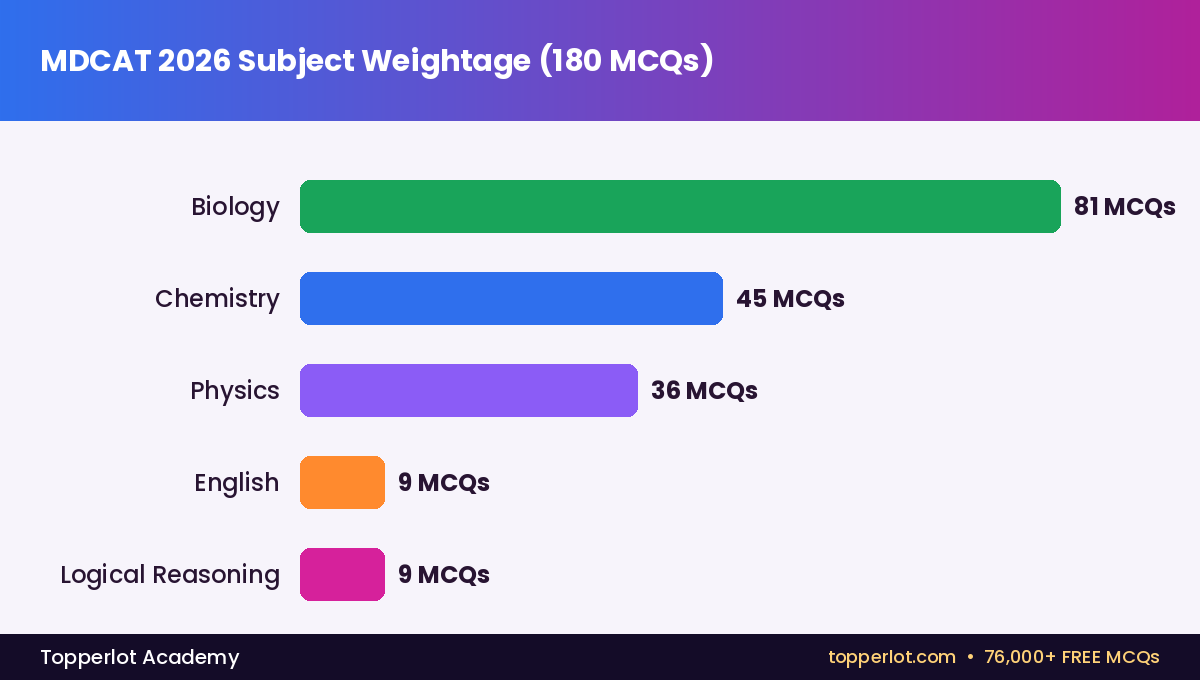
| Subject | MCQs | Share | Reading priority |
|---|---|---|---|
| Biology | 81 | 45% | Highest |
| Chemistry | 45 | 25% | High |
| Physics | 36 | 20% | Medium |
| English | 9 | 5% | Light |
| Logical Reasoning | 9 | 5% | Light |
Biology and Chemistry together are 126 of the 180 marks. Put your best books and most hours there. Physics needs a solid concept book and a lot of numerical practice. English and Logical Reasoning need very little reading and mostly practice, so do not spend money on thick books for the last 18 marks when a few practice sets will do.
Best books for Biology
Biology is 45% of the paper, so this is where books matter most. Your reading stack should look like this:
- Your FSc Biology board textbooks, read thoroughly. This is your primary source and answers a large part of the paper on its own.
- One reputable MDCAT Biology reference or MCQ book that follows the PMDC syllabus, used to add depth and to test yourself chapter by chapter. Pick one that gives explained answers, not just a key.
- A large explained MCQ bank for volume, since Biology rewards seeing many question styles on the same concept.
Focus your reading on the high-yield chapters: cell biology and division, genetics, human physiology, enzymes, biotechnology and classification. Read the concept in your board book, then solve MCQs on that chapter until you stop making the same mistakes. Build that volume in the Biology Question Bank and Biology Topical MCQs, and read our high-yield Biology topics guide to spend your time where the marks are.
Best books for Chemistry
Chemistry is 25% of the paper and splits into three parts that need different handling. Physical Chemistry rewards understanding and numericals, Organic rewards pattern learning of reactions, and Inorganic rewards careful memory of trends and facts.
- Your FSc Chemistry board textbooks, read for concept and for the exact definitions examiners use.
- One good MDCAT Chemistry reference or MCQ book aligned to the PMDC syllabus, especially for Organic reaction practice and Physical numericals.
- Plenty of explained MCQs to drill reactions and calculations until they feel automatic.
Give Organic Chemistry special attention, since its reactions of alcohols, aldehydes, ketones, carboxylic acids and amines recur heavily. Learn the reaction maps, then test them. Use the Chemistry Question Bank and Chemistry Topical MCQs to build accuracy.
Best books for Physics
Physics is 20% of the paper and scares students who dislike numericals, but it is very scoreable because the question types repeat. You need a book that explains concepts clearly and a large set of solved and practice numericals.
- Your FSc Physics board textbooks for the core concepts and formulas.
- One MDCAT Physics reference or MCQ book with worked numericals, so you learn the method, not just the answer.
- A big pool of practice numericals, because speed and accuracy here come only from repetition.
Concentrate on the recurring areas: waves and oscillations, electromagnetic induction, electrostatics, nuclear physics and optics. Make a one-page formula sheet from your book and drill formula-based MCQs until the common ones are automatic. Practise in the Physics Question Bank and Physics Topical MCQs.
Best books for English
English is only 5% of the paper, so this is not where you spend money on a thick grammar book. The MDCAT English section tests reading comprehension, vocabulary in context, and basic grammar and sentence correction. A short review of grammar rules plus steady practice is enough.
Use a concise grammar reference you already own, or the grammar notes in a general MDCAT guide, and put your time into practice questions instead. These 9 marks are easy to secure and easy to lose to carelessness, so treat them as quick, certain points. Drill them in the English Question Bank.
Best books for Logical Reasoning
Logical Reasoning is the other 5%, and it is a skill you sharpen by doing, not by reading theory. The section covers number series, analogies, pattern recognition and simple syllogisms. A dedicated book is rarely needed. What you need is exposure to enough question types that none surprises you on the day.
Solve sets regularly so the patterns become familiar, and note the few tricks that catch you out. A short daily habit is enough to lock in most of these marks. Practise in the Logical Reasoning section until the common patterns feel routine.
Past papers are a book too
The most underrated book on any MDCAT reading list is not a guide at all. It is the collection of past papers. Real past questions show you the exact style, difficulty and phrasing the examiners use, which no commercial guide can fully copy. Working through several years of papers teaches you what actually gets asked and calibrates your preparation better than anything else.
Treat past papers as both study material and mock tests. Solve older papers by topic while you learn, then sit recent ones under full timed conditions near the exam. Use the MDCAT Yearly Past Papers for this, and read our MDCAT 2026 paper pattern guide so you know what to expect.
Why books alone are not enough
Here is the honest limit of any book. Reading builds understanding, but the MDCAT tests applied understanding under time, and that skill comes only from solving many MCQs and reviewing your mistakes. A student who reads five books but solves few questions will be slower and less accurate than a student who read one board book well and drilled thousands of MCQs.
Printed MCQ books also run out. Even a thick guide has a fixed, limited number of questions, and once you have seen them you start remembering answers instead of thinking. A large, refreshed online bank does not run out and can show you many question styles on the same concept. That is why the strongest setup is board textbooks for concepts, a reference book or two for depth, and a big online MCQ bank for the volume that actually builds your score.
How to actually use your books
Owning the right books does nothing on its own. Use them in a loop:
- Read one chapter in your board textbook until the concept is clear, not just familiar.
- Add depth from your reference book for the harder or high-yield parts of that chapter.
- Solve MCQs on that chapter, first untimed to learn, then timed to build speed.
- Review every wrong answer and note the exact reason you missed it.
- Return to that chapter a week later and re-test, so it moves into long-term memory.
This concept then practice then review loop is what turns pages into marks. A book you read once and never test yourself on is close to wasted. A book you read, drill and revisit becomes real knowledge you can use under exam pressure.
Buying books or studying free
A stack of MDCAT books can cost several thousand rupees, and academy notes add more. That is fine if you use them, but it is worth knowing that you do not have to spend heavily to prepare well. Your board textbooks you already own. Past papers are freely available. And a complete explained MCQ bank is available free online.
Topperlot gives you 76,000+ topic-wise MCQs across all five subjects, each with a detailed explanation, plus full subject question banks, updated past papers, a revision test series with national ranking, and the KPK, Federal and Punjab board exercises. Everything is free with a free account, and it runs in a phone browser. So a realistic budget setup is simple: your board textbooks, one good reference book per heavy subject if you want it, and Topperlot for all the practice. For the wider case, see our guide to the best website for MDCAT preparation.
A simple book plus practice routine
Pull it together into a routine you can run every day:
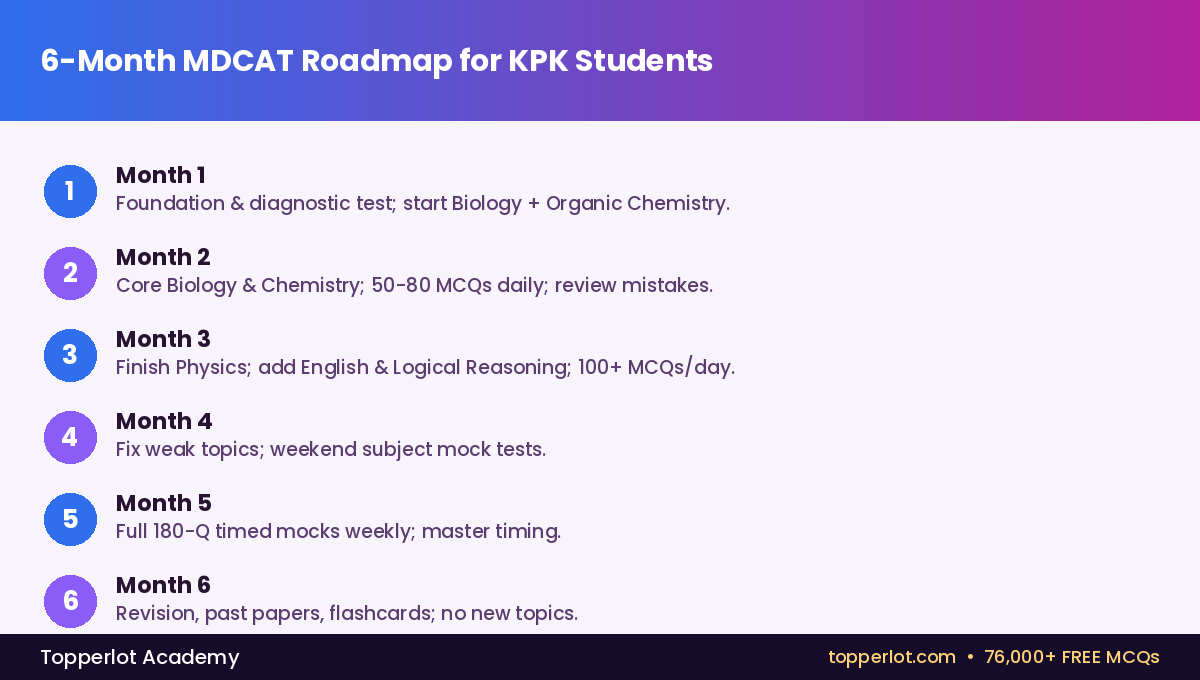
- Morning: read and understand a new chapter from your board textbook, adding depth from a reference where needed.
- Afternoon: solve MCQs on that chapter and on an older chapter, and review every mistake.
- Weekend: sit a subject mock early on, then full 180-question mocks as the exam nears.
- Ongoing: work steadily through past papers, first by topic, then as timed tests.
Follow this and your books stop being a pile you feel guilty about and become a system that adds marks. For the full method, read our complete MDCAT preparation guide.
Mistakes students make with books
A few book habits cost students marks every year. The first is buying too many guides and finishing none, which spreads attention thin. The second is skimming the board textbook while trusting a commercial guide, when the board book is the real source. The third is reading passively and never testing, so nothing sticks under pressure. Two more matter: ignoring past papers until the last week, and spending on thick English and Logical Reasoning books when a little practice would do. Choose a small correct set, test yourself constantly, and let past papers guide you.
Key takeaways
The best books for MDCAT 2026 start with your FSc board textbooks, which the paper is built on, then one good reference or MCQ book for each heavy subject, and past papers for real question style. Biology and Chemistry deserve the most reading, English and Logical Reasoning the least. Books build concepts, but MCQ practice builds the score, so back your reading with a large explained bank. Topperlot provides 76,000+ free MCQs, past papers and KPK board exercises, so you can prepare well without a heavy book budget.
Turn your books into marks
Read your board texts, then drill 76,000+ explained MCQs and past papers free on Topperlot.
Frequently asked questions
What are the best books for MDCAT 2026?
Start with your FSc board textbooks, which the MDCAT is built on, then add one reputable reference or MCQ book aligned to the PMDC syllabus for each heavy subject, plus past papers. Back all of it with a large explained MCQ bank, since practice builds the score more than reading alone.
Are board textbooks enough for the MDCAT?
They are the most important source and answer a large part of the paper, especially in Biology, but they are best paired with heavy MCQ practice and past papers. Concepts come from the board book, exam skill comes from solving questions under time.
Which subject needs the most books?
Biology, at 45% of the paper, followed by Chemistry at 25%. Put your best books and most hours there. Physics needs a concept book plus numerical practice, and English and Logical Reasoning need very little reading and mostly practice.
Do I need to buy expensive MDCAT books?
No. Your board textbooks you already own, past papers are freely available, and a complete explained MCQ bank is free on Topperlot. One good reference book per heavy subject is optional if you want extra depth.
Are MCQ books better than concept books?
They serve different jobs. Concept books teach, MCQ books test. Use a concept or board book to learn a chapter, then an MCQ book or bank to drill it. A pure MCQ book only helps once your concepts are solid.
How important are past papers?
Very. Past papers show the exact style and difficulty examiners use, which no commercial guide fully copies. Solve older papers by topic while learning, then recent ones as timed mocks near the exam.
Should KPK students use KPK board books?
Yes. Read your KPK Textbook Board books as your primary source, and use the KPK Board Exercise on Topperlot so your practice matches the textbooks you studied. Where the national syllabus points to Federal content, cover that too.
How many MDCAT books should I buy?
Fewer than you think. Your board textbooks, one reference or MCQ book for each of Biology, Chemistry and Physics if you want them, and past papers. A tall stack you skim is worse than a small set you finish and test yourself on.
Can I prepare for MDCAT without buying any extra books?
Yes. Many students prepare well using only their board textbooks, freely available past papers, and a free online MCQ bank such as Topperlot for all their practice. Extra reference books are optional, not required.
How do I use my MDCAT books effectively?
Run a loop: read a chapter in your board book, add depth from a reference, solve MCQs on it, review every mistake, then re-test a week later. This concept then practice then review cycle turns reading into marks.
Start your MDCAT 2026 preparation today
Books teach the concepts, practice wins the seat. Create your free Topperlot account, read your board texts alongside 76,000+ explained MCQs, past papers and KPK exercises, and message the team on WhatsApp at 0316 0541707 if you need help.