
MDCAT Time Management 2026: Study Schedule and Exam-Day Timing Guide
Table of contents
- Why time management decides your score
- The two kinds of MDCAT time management
- Building your daily study schedule
- A weekly structure that works
- Giving each subject the right time
- The six-month macro plan
- Study in focused blocks
- Balancing college with MDCAT prep
- Exam-day timing strategy
- The one-minute rule
- Managing the final thirty minutes
- Time mistakes that cost marks
- Frequently asked questions
Two students can know the same amount and walk out with very different scores. The difference is often time. One planned the months so nothing was left half-learned, then paced the paper so every question got a fair attempt. The other ran out of syllabus before the exam and ran out of clock inside it. MDCAT time management is not a soft skill. It is a scoring skill, and this guide teaches it in both forms.
Why time management decides your score
The MDCAT gives you 180 MCQs in 180 minutes. That is one minute per question on average, with no spare time built in. There is also no negative marking, so every question left blank because you ran out of time is a certain zero you could have scored on. A student who freezes on hard questions and never reaches the last twenty can lose more marks to the clock than to gaps in knowledge.
MDCAT time management for the months works the same way. The syllabus is large, and the merit for a government seat is high. If you drift for the first three months and then panic, you will not finish the syllabus, let alone revise it. Good time management over the months is what lets steady, ordinary daily effort add up to a strong score. This is why serious aspirants treat their calendar and their exam clock as seriously as their books.
The two kinds of MDCAT time management
Keep these two separate in your mind, because they need different habits.
The first is preparation time management. This is how you spend your weeks and months: covering the syllabus in order, giving heavy subjects more hours, practising daily, and revising on a schedule so nothing fades. Get this wrong and you arrive at the exam underprepared, no matter how clever your exam-day plan is.
The second is exam-day time management. This is how you spend the three hours in the hall: pacing yourself, not getting stuck, marking and moving on, and making sure every question is at least attempted. Get this wrong and you leave marks on the table even though you knew the answers. You need to train both, and the good news is that regular full-length mock tests build both at once.
Building your daily study schedule
A daily schedule removes the daily decision of what to study, which is where hours leak away. Build yours around a few fixed blocks rather than a vague plan to study a lot. A workable full-time day looks like this:
- Morning block: your hardest new learning, usually Biology or Chemistry concepts, when your mind is freshest.
- Midday block: MCQ practice on what you learned, plus a set from an older chapter to keep it warm.
- Afternoon block: the second heavy subject, or Physics numericals, with practice straight after.
- Evening block: light work, English or Logical Reasoning practice, and review of the day’s mistakes.
Notice the pattern. Every learning block is followed by practice, because reading without testing does not stick. If you study alongside college, shrink the blocks but keep the shape: learn something, practise it, review it, every day. Consistency beats the occasional marathon.
A weekly structure that works
Days handle learning. Weeks handle balance and testing. Plan your week so every subject gets touched and one day is set aside to measure progress:
| Day type | Focus |
|---|---|
| Five learning days | New chapters plus daily MCQ practice, weighted to Biology and Chemistry |
| One test day | A subject mock early on, a full 180-question mock as the exam nears |
| One lighter day | Review the week’s mistakes, revise weak chapters, rest a little |
The test day is not optional. It is how you find out whether your daily work is landing and how you train exam-day pacing. Sit each mock under real conditions, then spend serious time reviewing it. Build these mocks from the Revision Test Series and past papers.
Giving each subject the right time
Your hours should follow the marks. Splitting time equally across five subjects is a common and costly mistake, because the subjects are not worth equal marks:
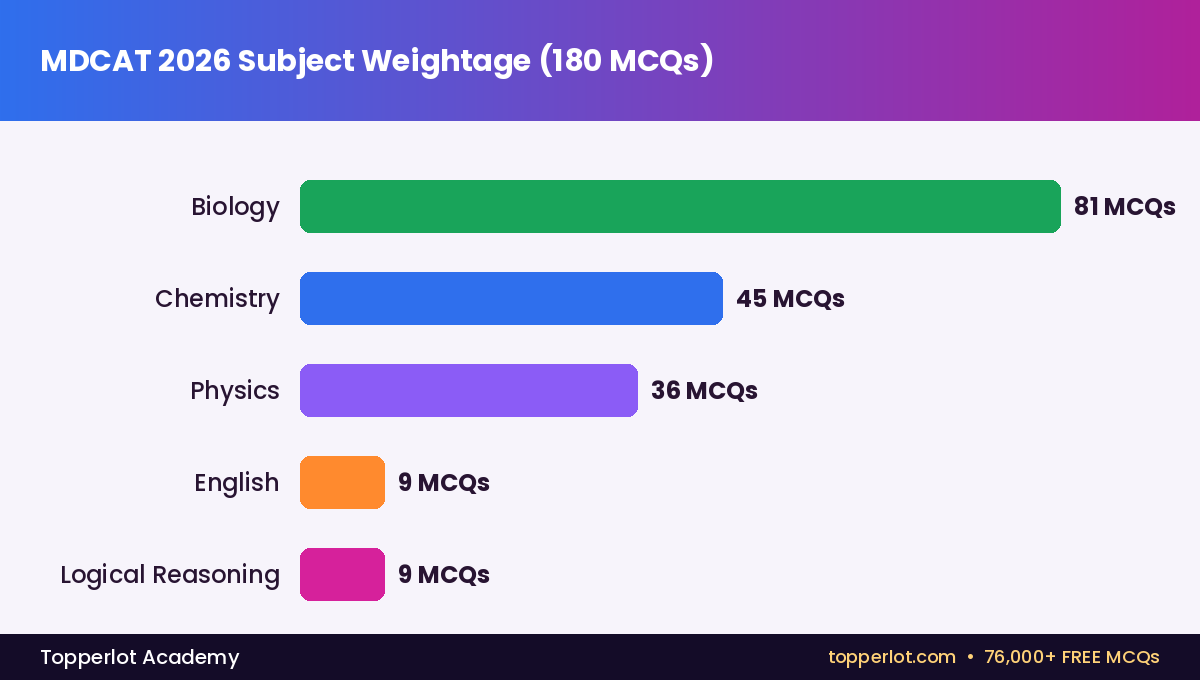
| Subject | MCQs | Share | Time share |
|---|---|---|---|
| Biology | 81 | 45% | Most |
| Chemistry | 45 | 25% | Second most |
| Physics | 36 | 20% | Solid |
| English | 9 | 5% | Light, steady |
| Logical Reasoning | 9 | 5% | Light, steady |
Give Biology the most daily time and Chemistry the second most, since together they are 126 of the 180 marks. Physics needs a steady share for numerical practice. English and Logical Reasoning need only short, regular sessions, because a little practice secures those 18 marks and more time there adds almost nothing. Practise the heavy subjects in the Biology and Chemistry banks first.
The six-month macro plan
Zoom out from days and weeks to the whole run-up. A six-month shape keeps you on track:
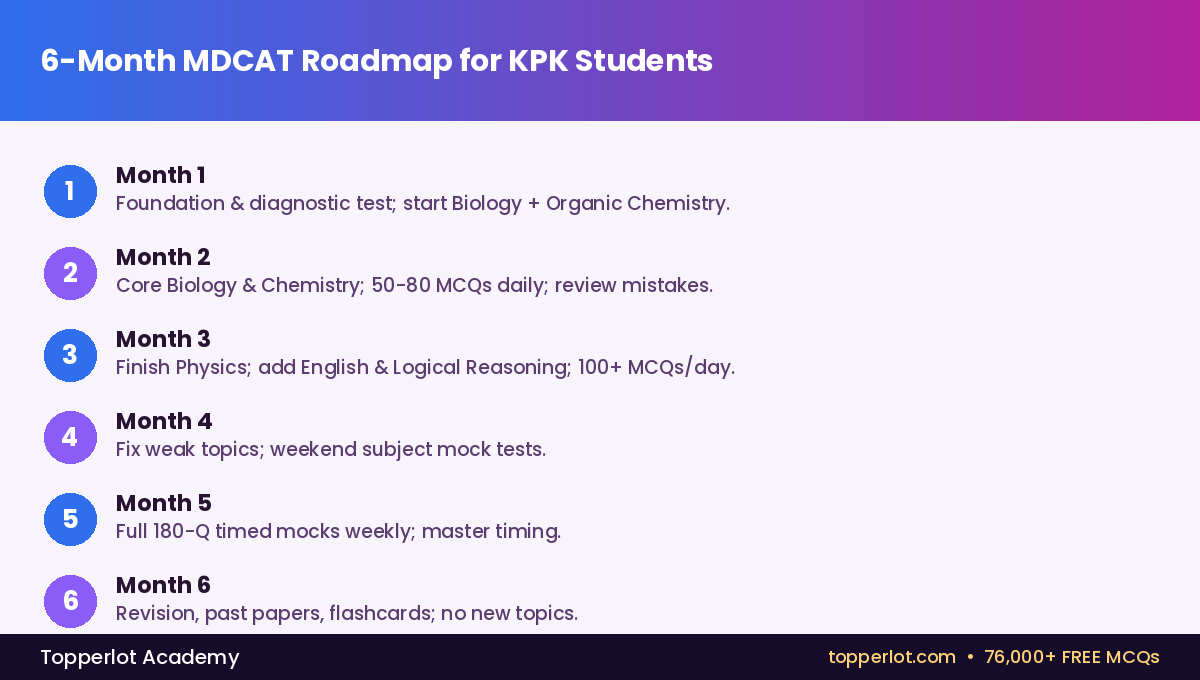
- Month 1: diagnostic test, set your routine, begin Biology and Organic Chemistry.
- Month 2: most of Biology, finish Organic and start Physical Chemistry, 50 to 80 MCQs a day.
- Month 3: complete Physics, keep Biology and Chemistry warm, add short English and Logical Reasoning practice.
- Month 4: attack your weakest chapters from your mistake record, sit subject mocks each weekend.
- Month 5: full 180-question mocks weekly, work hard on pacing.
- Month 6: stop new topics, revise through summaries and past papers, protect your sleep.
If you have less than six months, keep the order and compress each stage, but never skip the mock-test phase, since that is where exam-day timing is trained. For the full method, follow our complete MDCAT preparation guide and the KPK study plan.
Study in focused blocks
Long, unfocused hours feel productive and rarely are. Your brain holds attention best in blocks, so study in stretches of roughly forty to fifty minutes with a short break between them. In each block, do one thing only: learn a chapter, or drill one subject, or review mistakes. Switching tasks every few minutes wastes the start-up time each task needs.
Put your phone in another room during a block, not just face down. The habit of glancing at it breaks concentration far more than students think, and it quietly stretches a one-hour task into two. If focus is your real problem, treat it seriously and read our guide on how to stay focused and remove distractions for the MDCAT.
Balancing college with MDCAT prep
Many MDCAT aspirants are still in FSc or college, so their day is not empty. The answer is not to study more hours than you have. It is to protect a few high-quality blocks and use small gaps well. A student with three focused, well-planned hours a day, every day, will beat one who studies six distracted hours twice a week.
Use travel and waiting time for quick MCQ sets on your phone, since a good platform runs in a browser. Keep your heaviest learning for your one or two protected blocks at home, and let college handle some of the concept work, because the FSc syllabus and the MDCAT overlap heavily. The goal is steady daily contact with the material, not a heroic weekend that leaves you exhausted.
Exam-day timing strategy
All the preparation in the world can still be undone by poor pacing in the hall. Go in with a clear plan for the three hours. Start with the section you are strongest and fastest in, so you bank easy marks early and settle your nerves. Many students begin with Biology for this reason. Keep moving at a steady pace and resist the urge to prove yourself on a single hard question early on.
Do a rough time check at intervals, for example after each subject block, so you know if you are ahead or behind. Because there is no negative marking, your goal is to reach and attempt every one of the 180 questions. A confident guess on a question you did not fully solve is worth far more than a perfect answer you never reached because you overspent elsewhere.
The one-minute rule
The single most useful exam-day habit is the one-minute rule. You have on average one minute per question, so if a question is taking clearly longer than that and you are stuck, mark it, put down your best guess, and move on. You can return to it if time remains. What you must not do is sink three or four minutes into one stubborn question while ten easier ones wait unseen at the back of the paper.
Train this in practice, not just on exam day. When you sit mock tests, use a clock and force yourself to move on from time-sinks. After a few timed mocks, the instinct to abandon a stuck question becomes automatic, and that instinct alone can add several marks by making sure you attempt the whole paper.
Managing the final thirty minutes
Plan the last half hour before you ever sit down. First, make sure no question is left blank, because a blank scores nothing and a guess might score. Fill in any you skipped with your best elimination-based guess. Then, if time remains, return to the questions you marked as difficult and give them a second, calmer look. Finally, spend the last couple of minutes checking that your answer sheet is filled correctly and no bubble is misaligned, since a shifted row can quietly cost you a run of marks.
Do not use the final minutes to second-guess and change many answers on a whim. Change an answer only if you have a clear reason. Panic-driven changes near the end tend to turn right answers into wrong ones.
Time mistakes that cost marks
A few timing errors show up again and again. The first is starting serious preparation too late, so the syllabus is never fully covered. The second is studying without daily practice, which feels busy but builds neither speed nor accuracy. The third is never sitting full timed mocks, so exam-day pacing is untrained. Two more matter in the hall: getting stuck on hard questions and abandoning the one-minute rule, and leaving questions blank when a guess costs nothing. Fix these, and the same knowledge produces a noticeably higher score. To check where your current pace puts you, sit a full mock and then use the KPK aggregate calculator to see your projected merit.
Key takeaways
MDCAT time management has two halves. Manage your months with a daily schedule that pairs learning and practice, gives Biology and Chemistry the most time, and revises on a plan. Manage the exam with the one-minute rule, a strong-subject-first start, and a clear final-thirty-minutes routine so no question is left blank. Train both by sitting full timed mocks, and remember that with no negative marking, attempting every question is itself a scoring strategy.
Practise your pacing free
Sit full timed mocks and drill 76,000+ MCQs on Topperlot to train exam-day timing.
Frequently asked questions
How much time do you get per question in the MDCAT?
The MDCAT gives 180 MCQs in 180 minutes, so about one minute per question on average. There is no spare time built in, which is why pacing and the one-minute rule matter so much.
How should I manage time on MDCAT exam day?
Start with your strongest section to bank easy marks, keep a steady pace, and use the one-minute rule: if you are stuck, mark it, guess, and move on. Do time checks after each subject block, and make sure you attempt every question, since there is no negative marking.
What is the one-minute rule?
If a question is clearly taking longer than a minute and you are stuck, put down your best guess, mark it, and move on. This stops one hard question from eating the time of several easier ones you have not reached yet.
How many hours a day should I study for the MDCAT?
Consistency matters more than a fixed number. A few focused hours every day, weighted toward Biology and Chemistry with daily MCQ practice, beats long distracted sessions a couple of times a week.
How do I balance MDCAT prep with college?
Protect one or two high-quality study blocks at home for heavy learning, and use small gaps and travel time for quick MCQ sets on your phone. Since the FSc and MDCAT syllabus overlap, let college cover some concept work.
How do I stop running out of time in the MDCAT?
Train with full timed mocks so pacing becomes automatic, use the one-minute rule to avoid time-sinks, and start with your fastest section. Reaching and attempting all 180 questions is the goal.
Should I study all subjects equally?
No. Biology is 45% and Chemistry 25% of the paper, so they deserve the most time. Physics needs a solid share for numericals, while English and Logical Reasoning need only short, regular practice.
How do I build an MDCAT study schedule?
Use fixed daily blocks: heavy learning when fresh, practice straight after, and mistake review in the evening. Add one weekly test day and one lighter review day, and follow a six-month macro plan so the whole syllabus is covered and revised.
What should I do in the last 30 minutes of the exam?
Fill in any blank questions with a best guess, revisit the ones you marked as difficult, and check your answer sheet is bubbled correctly. Avoid changing many answers on a whim near the end.
Does practising mocks really improve timing?
Yes. Full timed mocks train your pace, your instinct to move on from stuck questions, and your stamina for three hours. It is the most reliable way to improve exam-day time management.
Start your MDCAT 2026 preparation today
Knowledge plus timing wins the seat. Create your free Topperlot account, build a daily routine around 76,000+ MCQs and full timed mocks, set your target with the KPK aggregate calculator, and message the team on WhatsApp at 0316 0541707 if you need help.