
MDCAT Biology Chapter-Wise Weightage 2026
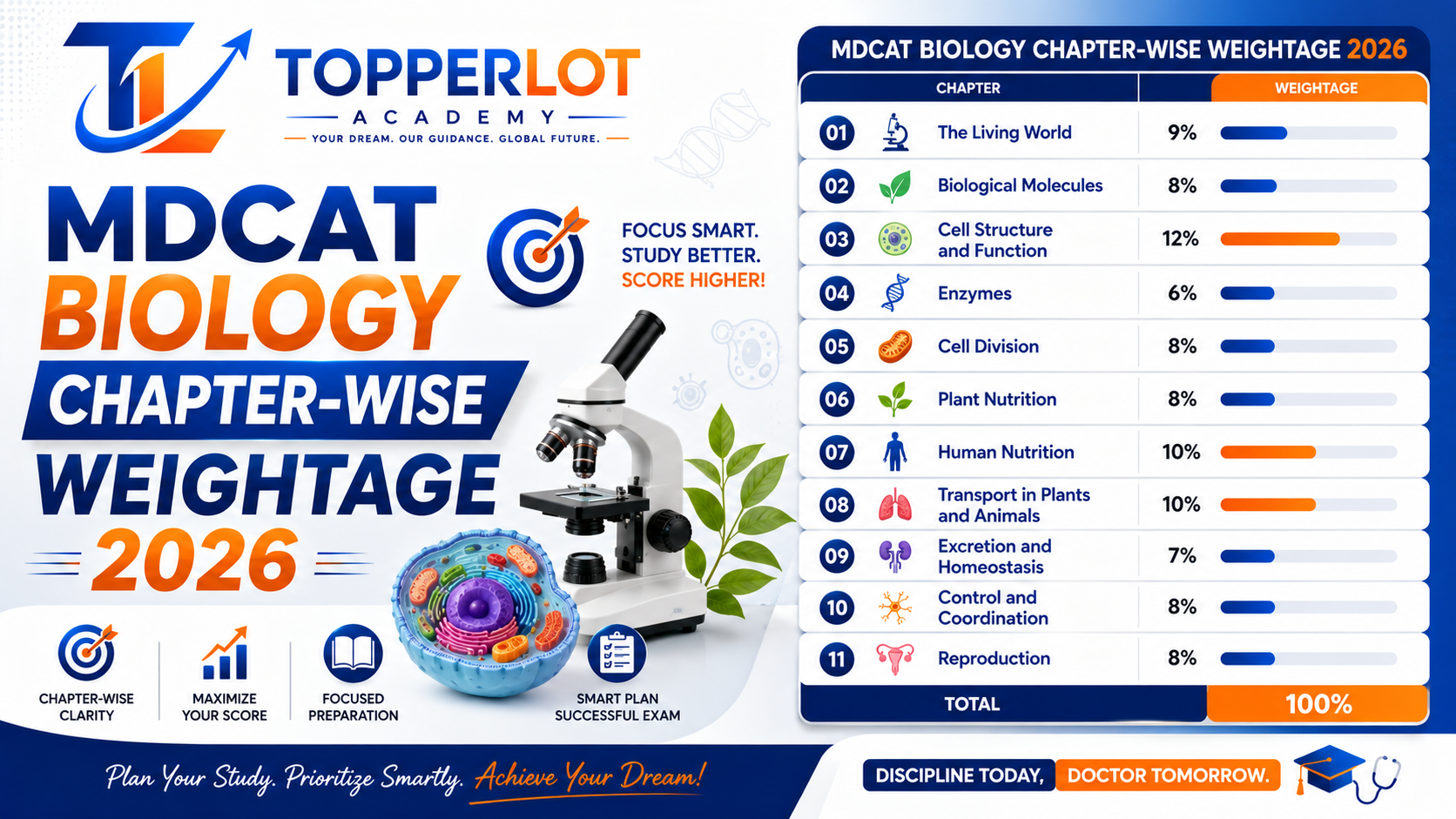
Table of contents
- What does the MDCAT Biology chapter-wise weightage look like in 2026?
- Why does chapter weightage matter for your merit?
- Which chapters are the most scoring for MDCAT Biology?
- How can I start MDCAT Biology preparation from zero?
- Is solving past papers enough for MDCAT Biology?
- How do I stop forgetting Biology MCQs I already solved?
- How do I balance MDCAT Biology preparation with FSc board exams?
- How can I use topic-wise revision tests to strengthen weak chapters?
- Frequently asked questions
What does the MDCAT Biology chapter-wise weightage look like in 2026?
No two MDCAT papers are identical, but the PMDC syllabus gives us a clear structure that has stayed fairly consistent. Based on recent papers and the latest official syllabus, Biology questions are pulled from around 14 to 16 chapters, with some chapters naturally carrying more MCQs. Always cross-check the official PMDC notification for the year you will appear, because small adjustments can happen. For now, here is the approximate chapter-wise distribution you are likely to see.
- Cell Structure and Function: 6–7 MCQs
- Biological Molecules: 7–8 MCQs
- Enzymes: 4–5 MCQs
- Bioenergetics: 4–5 MCQs
- Biodiversity (Acellular Life and Variety of Life): 5–6 MCQs
- Prokaryotes: 3–4 MCQs
- Protista and Fungi: 3–4 MCQs
- Plant Kingdom: 4–5 MCQs
- Animal Kingdom: 4–5 MCQs
- Human Physiology (all systems combined—digestive, respiratory, circulatory, excretory, nervous, coordination, reproduction, support and movement): 18–20 MCQs
- Homeostasis: 4–5 MCQs
- Biotechnology: 2–3 MCQs
- Evolution: 2–3 MCQs
- Ecology and Ecosystems: 2–3 MCQs
These numbers are not set in stone, but they give you a working map. If a chapter shows fewer MCQs, it does not mean you can skip it. It means you can adjust the depth of your revision once your high-weightage chapters are strong.
Why does chapter weightage matter for your merit?
When you look at the merit race, every single MCQ can shift your position. Biology, with its 68 marks, can make or break a comfortable admission. Spending extra time on chapters that repeatedly give you 6 to 8 direct questions is a smart move. You get more return on every hour you invest. At the same time, lower-weightage chapters often become tiebreakers. Many students ignore Evolution or Biotechnology, and a single unexpected MCQ from there can push a prepared student ahead. So weightage is not about ignoring something completely; it is about knowing where to build depth first and where to maintain light, consistent touch.
Which chapters are the most scoring for MDCAT Biology?
You probably already sense that Human Physiology tops the list. It is not one chapter, it is a family of topics: digestion, respiration, circulation, excretion, nervous coordination, chemical coordination, reproduction, and support and movement. Together they can contribute nearly 20 MCQs. The questions are often conceptual and application-based, mixing diagrams and clinical correlations. Right behind physiology, Cell Structure and Function and Biological Molecules consistently show up with solid numbers. These two chapters form the language of biology, and once you master them, many other topics start making more sense. Enzymes, Bioenergetics, Biodiversity, and the Plant and Animal Kingdom chapters follow. Many students underprepare Plant Kingdom or Biodiversity and lose marks that are not hard to get. If you treat these chapters with the same seriousness as physiology, you can collect a steady stream of correct answers.
How can I start MDCAT Biology preparation from zero?
Starting from zero feels heavy, but millions have done it before you, and there is a simple path. First, do not try to learn all chapters at once. Pick one high-weightage chapter, open your FSc textbook, and read the topic with full attention. Then immediately solve topic-wise MCQs. The fastest way to turn passive reading into active memory is to test yourself right after you study a small section. For example, after finishing the circulatory system, solve 30–40 MCQs only on that topic. You will see which points you missed. That immediate feedback fixes weak spots before they pile up. Rinse and repeat, chapter by chapter, and you will have covered the syllabus with understanding, not just surface-level familiarity.
A big help is having a question bank that lets you isolate any topic and filter by board. If you are preparing from KPK textbooks and want to see how questions are framed from the KPK board perspective, you need a resource that offers KPK board exercise MCQs. On Topperlot Academy, you can filter by chapter, topic, and board—whether it is KPK, FTB, or PTB—and practice exactly what your syllabus demands, all free. This removes guesswork and keeps your practice aligned with the kind of MCQs that actually appear.
Is solving past papers enough for MDCAT Biology?
Past papers are a powerful tool, but they are not a full strategy on their own. They show you recurring themes, the language examiners use, and the depth of concepts tested. However, if you limit yourself only to past papers, you may miss new angles or freshly added topics that the syllabus now includes. The best approach is to treat past papers as your progress checks. Solve one complete past paper after you have finished a set of chapters, then analyse every mistake. Identify which chapter the mistake came from and spend the next hour on that chapter’s topic-wise MCQs. This cycle of mixed past-paper practice and targeted topic-wise drilling is what builds both speed and accuracy.
How do I stop forgetting Biology MCQs I already solved?
Forgetting is not a sign that you are failing; it is how memory works. The brain needs repeated, timed exposure to move information into long-term memory. The most practical habit you can build is a weekly review slot. Every Saturday, for example, do not study anything new. Revisit the MCQs you got wrong during the week. Solve them again, but this time cover the answer and reason it out loud. If you still stumble, mark that chapter and give it extra attention. Tools that let you mark MCQs and filter weak areas make this painless. On Topperlot, you can tag questions during practice and later pull up a custom set of only your weak-chapter MCQs, without having to sift through notebooks.
How do I balance MDCAT Biology preparation with FSc board exams?
Many students feel torn between board exams and MDCAT, but the overlap is larger than you think. FSc theory is the foundation of MDCAT MCQs. When you study a chapter for your board exam, go one step further: solve 50 conceptual MCQs from that same chapter that same day. This way, you serve both goals without doubling your workload. During exam weeks, scale MDCAT practice down to 30–40 minutes a day of mixed MCQs from chapters you have already finished, so your touch stays alive. Right after board exams, you can ramp up dedicated MDCAT sessions with revision tests. Having a platform that includes board exercises from KPK, FTB, and PTB textbooks means you do not have to hunt for separate books. You simply open the topic and practice board exercise MCQs, which are often asked in a similar style in MDCAT.
How can I use topic-wise revision tests to strengthen weak chapters?
Once you have covered the syllabus once, revision tests become your best friend. Pick a day, select three chapters you find shaky, and take a custom revision test that mixes MCQs from just those chapters. Mark the questions you get wrong. The next day, go through the theory of those exact subtopics, then take another short test on the same chapters. You will see your accuracy climb in two or three rounds. It builds confidence quietly, without any dramatic pressure.
On Topperlot, you can create unlimited revision tests pulling MCQs from selected chapters and topics, so you never waste time on areas you already know well. The goal is to turn every weak chapter into a solid, average chapter first. You do not need to make everything perfect; you need to stop bleeding marks.
Key takeaways
Biology’s chapter-wise weightage shows that Human Physiology, Cell Biology, and Biological Molecules give you the most marks, but small chapters can decide your merit. Consistent topic-wise MCQs, regular revision tests, and board-aligned practice keep your preparation balanced and calm.
Start Your MDCAT 2026 Success Journey Today
Access free MCQs, past papers, topic-wise practice, and nationwide ranking tests—all in one place.
Frequently asked questions
Which chapter has the most weightage in MDCAT Biology?
Human Physiology carries the highest combined weight, often contributing 18 to 20 MCQs across all its systems. This includes digestion, respiration, circulation, excretion, nervous coordination, chemical coordination, reproduction, and support and movement. Right after that, Cell Structure and Function and Biological Molecules are the next heaviest individual chapters.
How many MCQs should I solve daily for MDCAT Biology?
A realistic and effective target is 80 to 100 Biology MCQs daily once you have built some momentum. In the early weeks, even 50 quality MCQs with proper review is solid. The key is not just solving but reviewing every mistake and understanding the concept behind it, so the number does not become empty speed.
I am starting MDCAT prep from zero. Should I read the whole textbook first?
No, that often leads to passive reading without memory. Read one topic at a time, then immediately solve MCQs on that topic. This active recall method shows you what you actually understood. After you finish a full chapter this way, attempt a chapter test and then move on. Starting from zero is completely okay if you stay topic-focused.
Are KPK, FTB, and PTB board exercises really important for MDCAT Biology?
Yes, because many MDCAT questions are directly inspired by board textbook exercises. Students who solve board exercise MCQs—especially the conceptual ones—often recognise familiar patterns in the exam. Practising board-aligned MCQs from all three boards, which are available topic-wise on Topperlot for free, helps you cover the full range of question styles without extra books.
I feel anxious and burned out during MDCAT prep. How do I handle it?
Burnout usually comes from an unsustainable schedule and isolation. Set a fixed finish time every day, sleep at least six to seven hours, and keep one half-day a week completely study-free. Talk to someone who understands the journey—a friend, a senior, or even our team on WhatsApp if you just need guidance. Small consistent steps protect your mental energy much better than heroic all-nighters.
Start Your MDCAT 2026 Success Journey Today
You can start solving chapter-wise MDCAT Biology MCQs, past papers, and board exercises right now on Topperlot Academy—completely free. Create your account at topperlot.com and build a daily routine that works for you. If you ever feel stuck or need help planning your revision, reach out to us on WhatsApp at 0316 0541707. We would love to help you stay steady and prepared.
Start Your MDCAT 2026 Success Journey Today
Access free MCQs, past papers, topic-wise practice, and nationwide ranking tests—all in one place.